Friday, 26 October 2018
The Everly Brothers - 1958 - They're Off And Rolling FLAC
Maybe Tomorrow/Brand New Heartache/I Wonder If I Care As Much/Hey Doll Baby
The Everly Brothers were not only among the most important and best early rock & roll stars, but also among the most influential rockers of any era. They set unmatched standards for close, two-part harmonies and infused early rock & roll with some of the best elements of country and pop music. Their legacy was and is felt enormously in all rock acts that employ harmonies as prime features, from the Beatles and Simon & Garfunkel to legions of country-rockers as well as roots rockers like Dave Edmunds and Nick Lowe (who once recorded an EP of Everlys songs together).
Don (born February 1, 1937) and Phil (born January 19, 1939) were professionals way before their teens, schooled by their accomplished guitarist father Ike, and singing with their family on radio broadcasts in Iowa. In the mid-'50s, they made a brief stab at conventional Nashville country with Columbia. When their single flopped, they were cast adrift for quite a while until they latched onto Cadence. Don invested their first single for the label, "Bye Bye Love," with a Bo Diddley beat that helped lift the song to number two in 1957.
"Bye Bye Love" began a phenomenal three-year string of classic hit singles for Cadence, including "Wake Up Little Susie," "All I Have to Do Is Dream," "Bird Dog," "('Til) I Kissed You," and "When Will I Be Loved." The Everlys sang of young love with a heart-rending yearning and compelling melodies. The harmonies owed audible debts to Appalachian country music, but were imbued with a keen modern pop sensibility that made them more accessible without sacrificing any power or beauty. They were not as raw as the wild rockabilly men from Sun Records, but they could rock hard when they wanted. Even their midtempo numbers and ballads were executed with a force missing in the straight country and pop tunes of the era. The duo enjoyed a top-notch support team of producer Archie Bleyer, great Nashville session players like Chet Atkins, and the brilliant songwriting team of Boudleaux and Felice Bryant. Don, and occasionally Phil, wrote excellent songs of their own as well.
In 1960, the Everlys left Cadence for a lucrative contract with the then-young Warner Bros. label (though it's not often noted, the Everlys would do a lot to establish Warners as a major force in the record business). It's sometimes been written that the duo never recaptured the magic of their Cadence recordings, but actually Phil and Don peaked both commercially and artistically with their first Warners releases. "Cathy's Clown," their first Warners single, was one of their greatest songs and a number one hit. Their first two Warners LPs, employing a fuller and brasher production than their Cadence work, were not just among their best work, but two of the best rock albums of the early '60s. The hits kept coming for a couple of years, some great ("Walk Right Back," "Temptation"), some displaying a distressing, increasing tendency toward soft pop and maudlin sentiments ("Ebony Eyes," "That's Old Fashioned").
Don and Phil's personal lives came under a lot of stress in the early '60s: they enlisted into the Marine Corps Reserves (together), and studied acting for six months but never made a motion picture. More seriously, Don developed an addiction to speed and almost died of an overdose in late 1962. By that time, their career as chart titans in the U.S. had ended; "That's Old Fashioned" (1962) was their last Top Ten hit. Their albums became careless, erratic affairs, which was all the more frustrating because many of their flop singles of the time were fine, even near-classic efforts that demonstrated they could still deliver the goods.
Virtually alone among first-generation rock & roll superstars, the Everlys stuck with no-nonsense rock & roll and remained determined to keep their sound contemporary, rather than drifting toward soft pop or country like so many others. Although their mid-'60s recordings were largely ignored in America, they contained some of their finest work, including a ferocious Top 40 single in 1964 ("Gone, Gone, Gone"). They remained big stars overseas -- in 1965, "Price of Love" went to number two in the U.K. at the height of the British Invasion. They incorporated jangling Beatle/Byrdesque guitars into some of their songs and recorded a fine album with the Hollies (who were probably more blatantly influenced by the Everlys than any other British band of the time). In the late '60s, they helped pioneer country-rock with the 1968 album Roots, their most sophisticated and unified full-length statement. None of this revived their career as hitmakers, though they could always command huge audiences on international tours and hosted a network TV variety show in 1970.
The decades of enforced professional togetherness finally took their toll on the pair in the early '70s, which saw a few dispirited albums and, finally, an acrimonious breakup in 1973. They spent the next decade performing solo, which only proved -- as is so often the case in close-knit artistic partnerships -- how much each brother needed the other to sound his best. In 1983, enough water had flowed under the bridge for the two to resume performing and recording together. The tours, with a backup band led by guitarist Albert Lee, proved they could still sing well. The records (both live and studio) were fair efforts that, in the final estimation, were not in nearly the same league as their '50s and '60s classics, although Paul McCartney penned a small hit single for them ("On the Wings of a Nightingale"). One of the more successful and dignified reunions in the rock annals, the Everlys continued to perform live, although they didn't release albums together after the late '80s. Phil Everly died on January 3, 2014 from complications of chronic obstructive pulmonary disease; he was 74 years old.
Friday, 19 October 2018
Jerry Lee Lewis - 1965 - Whole Lotta Shakin FLAC
Whole Lotta Shaking Going On/Great Balls Of Fire/High Heel Sneakers/High School Confidential
Jerry Lee Lewis (born September 29, 1935) is an American singer-songwriter, musician, and pianist, often known by his nickname, The Killer. He has been described as "rock & roll's first great wild man."
A pioneer of rock and roll and rockabilly music, Lewis made his first recordings in 1956 at Sun Records in Memphis. "Crazy Arms" sold 300,000 copies in the South, but it was his 1957 hit "Whole Lotta Shakin' Goin' On" that shot Lewis to fame worldwide. He followed this with "Great Balls of Fire", "Breathless" and "High School Confidential". However, Lewis's rock and roll career faltered in the wake of his marriage to his 13-year-old cousin.
He had minimal success in the charts following the scandal, and his popularity quickly eroded. His live performance fees plummeted from $10,000 per night to $250. In the meantime he was determined to gain back some of his popularity. In the early 1960s, he did not have much chart success, with few exceptions, such as a remake of Ray Charles's "What'd I Say". His live performances at this time were increasingly wild and energetic. His 1964 live album Live at the Star Club, Hamburg is regarded by music journalists and fans as one of the wildest and greatest live rock albums ever. In 1968, Lewis made a transition into country music and had hits with songs such as "Another Place, Another Time". This reignited his career, and throughout the late 1960s and 1970s he regularly topped the country-western charts; throughout his seven-decade career, Lewis has had 30 songs reach the top 10 on the "Billboard Country and Western Chart". His No. 1 country hits included "To Make Love Sweeter for You", "There Must Be More to Love Than This", "Would You Take Another Chance on Me", and "Me and Bobby McGee".
Lewis's successes continued throughout the decade and he embraced his rock and roll past with songs such as a cover of the Big Bopper's "Chantilly Lace" and Mack Vickery's "Rockin' My Life Away". In the 21st century Lewis continues to tour around the world and still releases new albums. His album Last Man Standing is his best selling to date, with over a million copies sold worldwide. This was followed by Mean Old Man, which has received some of the best sales of Lewis's career.
Lewis has a dozen gold records in both rock and country. He won several Grammy awards, including a Lifetime Achievement Award. Lewis was inducted into the Rock and Roll Hall of Fame in 1986, and his pioneering contribution to the genre has been recognized by the Rockabilly Hall of Fame. He was also a member of the inaugural class inducted into the Memphis Music Hall of Fame. In 1989, his life was chronicled in the movie Great Balls of Fire, starring Dennis Quaid. In 2003, Rolling Stone listed his box set All Killer, No Filler: The Anthology number 242 on their list of "500 Greatest Albums of All Time". In 2004, they ranked him number 24 on their list of the 100 Greatest Artists of All Time. Lewis is the last surviving member of Sun Records' Million Dollar Quartet and the Class of '55 album, which also included Johnny Cash, Carl Perkins, Roy Orbison and Elvis Presley.
Dion - 1962 - Twist With Dion FLAC
Runaround Sue/Dream Lover/The Majestic/ Kansas City
Bridging the era between late-'50s rock and the British Invasion, Dion DiMucci (born July 18, 1939) was one of the top white rock singers of his time, blending the best elements of doo wop, teen idol, and R&B styles. Some revisionists have tried to cast him as a sort of early blue-eyed soul figure, although he was probably more aligned with pop/rock, at first as the lead singer of the Belmonts, and then as a solo star. Drug problems slowed him down in the mid-'60s, yet he made some surprisingly interesting progressions into blues-rock and folk-rock as the decade wore on, culminating in a successful comeback in the late '60s, although he was unable to sustain its commercial and artistic momentum for long.
When Dion began recording in the late '50s, it was as the lead singer of a group of friends who sang on Bronx street corners. Billing themselves Dion & the Belmonts (Dion had released a previous single with the Timberlanes), their first few records were prime Italian-American doo wop; "I Wonder Why" was their biggest hit in this style. Dion's biggest single with the Belmonts was "A Teenager in Love," which pointed the way for the slightly self-pitying, pained odes to adolescence and early adulthood that would characterize much of his solo work.
Dion went solo in 1960 (the Belmonts did some more doo wop recordings on their own), moving from doo wop to more R&B/pop-oriented tunes with great success. He handled himself with a suave, cocky ease on hits like "The Wanderer," "Runaround Sue," "Lovers Who Wander," "Ruby Baby," and "Donna the Prima Donna," which cast him as either the jilted, misunderstood youngster or the macho lover, capable of handling anything that came his way (especially on "The Wanderer").
In 1963, Dion moved from Laurie to the larger Columbia label, an association that started promisingly with a couple of big hits right off the bat, "Ruby Baby" and "Donna the Prima Donna." By the mid-'60s, his heroin habit (which he'd developed as a teenager) was getting the best of him, and he did little recording and performing for about five years. When he did make it into the studio, he was moving in some surprisingly bluesy directions; although much of it was overlooked or unissued at the time, it can be heard on the Bronx Blues reissue CD.
In 1968, he kicked heroin and re-emerged as a gentle folk-rocker with a number four hit single, "Abraham, Martin and John." Dion would focus upon mature, contemporary material on his late-'60s and early-'70s albums, which were released to positive critical feedback, if only moderate sales. The folk phase didn't last long; in 1972 he reunited with the Belmonts and in the mid-'70s cut a disappointing record with Phil Spector as producer. He recorded and performed fairly often in the years that followed (sometimes singing Christian music), to indifferent commercial results. But his critical rep has risen steadily since the early '60s, with many noted contemporary musicians showering him with praise and citing his influence, such as Dave Edmunds (who produced one of his periodic comeback albums) and Lou Reed (who guested on that record).
Dion continued to be active as the 21st century opened, releasing Déjà Nu in 2000, Under the Influence in 2005, and Bronx in Blue in 2006. His first major-label album since 1989's Yo Frankie, Son of Skip James was released by Verve in 2007, while 2008's Heroes: Giants of Early Guitar Rock saw him tackling 15 songs from the classic rock & roll era. Influenced by a conversation with rock critic Dave Marsh about his long and still relevant career, and a dare from his wife Susan to prove it, Dion cut Tank Full of Blues, producing and playing the guitars himself on the recording and writing or co-writing all but one track on the set. Issued on Blue Horizon, it is the final recording in the trilogy that began with Bronx in Blue.
Dion signed to Instant Records in 2015 and immediately set to recording a new studio album. Entitled New York Is My Home, its first single and title track -- a duet with Paul Simon -- was pre-released in November digitally and as a striking video. The album was issued in the winter of 2016.
Then the singer/songwriter and Norton Records surprised everyone. In 1965, DiMucci was signed to Columbia, and had cut 15 new songs -- all produced by Tom Wilson, who was recording Bob Dylan in the same studios at roughly the same time -- for an album that the label, for whatever reason, decided not to release. Dion left the label over the decision. Some tracks were issued on singles, others later on various compilations. But for over 50 years, the tapes sat. That's where Norton's Miriam Linna and Billy Miller came in. They received the rights to release the entire record as it was originally intended, completely remastered from the original tapes. Featuring ten originals, one by Mort Shuman (who had co-written "Teenager in Love" with Doc Pomus for Dion & the Belmonts), and three by Dylan (who had been enamored with Dion since the '50s). Though Miller passed before it was issued, Kickin' Child: The Lost Columbia Album 1965 was released by the label in May 2017.
Thursday, 11 October 2018
The Hollies - 1964 - The Hollies FLAC
Rockin' Robin/What Kind of Love/Whatcha Gonna Do 'Bout It/When I'm Not There
The Hollies, five-piece rock group from Manchester, England, that enjoyed many hits in the 1960s both before and after losing singer-guitarist Graham Nash to a more-celebrated partnership with David Crosby, Stephen Stills, and Neil Young. The principal members were Allan Clarke (b. April 5, 1942, Salford, Lancashire, England), Graham Nash (b. February 2, 1942, Blackpool, Lancashire), Tony Hicks (b. December 16, 1943, Nelson, Lancashire), Eric Haydock (b. February 3, 1943, Burnley, Lancashire), Bernie Calvert (b. September 16, 1943, Burnley), and Terry Sylvester (b. January 8, 1947, Liverpool, Merseyside).
Like most of their contemporaries in the British beat boom, the Hollies found their earliest influences in American rhythm-and-blues artists. Their first hits in the United Kingdom, in 1963–64, were with cover versions of the Coasters’ “(Ain’t That) Just Like Me” and “Searchin’,” Maurice Williams and the Zodiacs’ “Stay,” and Doris Troy’s “Just One Look.” Under the influence of Bob Dylan, however, their approach broadened, including diluted elements of folk music, to the particular benefit of Clarke.
A strong lead singer, he received fine support from the harmony singing of Hicks, Nash, and, after the latter’s departure in 1968, Sylvester on “Here I Go Again” (1964), “I’m Alive” (1965), “Bus Stop” (1966, their first entry into the American top 10), and “He Ain’t Heavy, He’s My Brother” (1969). At their best the Hollies established a clear balance between the various components at play in their music, developing (like their Liverpool contemporaries the Searchers) a style that provided a useful template for a new generation of power pop groups, many of them American, such as the Raspberries and the Rubinoos. Unlike most groups of their vintage, the Hollies had their greatest successes in the 1970s, with “Long Cool Woman (in a Black Dress)” (1972) and “The Air That I Breathe” (1974). The group was inducted into the Rock and Roll Hall of Fame in 2010.
Wednesday, 3 October 2018
Johnny Winter - 1970 - Rollin' and Tumblin' FLAC
Rollin' and Tumblin'/Bad Luck and Trouble/Broke Down Engine/Black Cat Bone
Johnny Winter was born in Beaumont, Texas, on February 23, 1944. Winter and younger brother Edgar (born 1946) were nurtured at an early age by their parents in musical pursuits. Johnny and his brother, both of whom were born with albinism, began performing at an early age. When he was ten years old, the brothers appeared on a local children's show with Johnny playing ukulele.
His recording career began at the age of fifteen, when his band Johnny and the Jammers released "School Day Blues" on a Houston record label. During this same period, he was able to see performances by classic blues artists such as Muddy Waters, B.B. King, and Bobby Bland. In the early days, Winter would sometimes sit in with Roy Head and the Traits when they performed in the Beaumont area, and in 1967, Winter recorded a single with the Traits: "Tramp" backed with "Parchman Farm" (Universal Records 30496). In 1968, he released his first album The Progressive Blues Experiment, on Austin's Sonobeat Records.
Winter caught his biggest break in December 1968, when Mike Bloomfield, whom he met and jammed with in Chicago, invited him to sing and play a song during a Bloomfield and Al Kooper concert at the Fillmore East in New York City. As it happened, representatives of Columbia Records (which had released the Top Ten Bloomfield/Kooper/Stills Super Session album) were at the concert. Winter played and sang B.B. King's "It's My Own Fault" to loud applause and, within a few days, was signed to what was reportedly the largest advance in the history of the recording industry at that time—$600,000.
Winter's first Columbia album, Johnny Winter, was recorded and released in 1969. It featured the same backing musicians with whom he had recorded The Progressive Blues Experiment, bassist Tommy Shannon and drummer Uncle John Turner, plus Edgar Winter on keyboards and saxophone, and (for his "Mean Mistreater") Willie Dixon on upright bass and Big Walter Horton on harmonica. The album featured a few selections that became Winter signature songs, including his composition "Dallas" (an acoustic blues, on which Winter played a steel-bodied, resonator guitar), John Lee "Sonny Boy" Williamson's "Good Morning Little School Girl", and B.B. King's "Be Careful with a Fool".
The album's success coincided with Imperial Records picking up The Progressive Blues Experiment for wider release. The same year, the Winter trio toured and performed at several rock festivals, including Woodstock. With brother Edgar added as a full member of the group, Winter also recorded his second album, Second Winter, in Nashville in 1969. The two-record album, which only had three recorded sides (the fourth was blank), introduced a couple more staples of Winter's concerts, including Chuck Berry's "Johnny B. Goode" and Bob Dylan's "Highway 61 Revisited". Also at this time Johnny entered into an intimate, albeit short-lived affair with Janis Joplin, which culminated in a concert at New York's Madison Square Garden, where Johnny joined her on stage to sing and perform.
In 1970, when his brother Edgar released a solo album Entrance and formed Edgar Winter's White Trash, an R&B/jazz-rock group, the original trio disbanded. Johnny Winter then formed a new band with the remnants of the McCoys—guitarist Rick Derringer, bassist Randy Jo Hobbs, and drummer Randy Z (who was Derringer's brother, their family name being Zehringer). Originally to be called "Johnny Winter and the McCoys", the name was shortened to "Johnny Winter And", which was also the name of their first album. The album included Derringer's "Rock and Roll, Hoochie Koo" and signaled a more rock-oriented direction for Winter. When Johnny Winter And began to tour, Randy Z was replaced with drummer Bobby Caldwell. Their mixture of the new rock songs with Winter's blues songs was captured on the live album Live Johnny Winter And. It included a new performance of "It's My Own Fault", the song which brought Winter to the attention of Columbia Records.
Winter's momentum was throttled when he sank into heroin addiction during the Johnny Winter And days. After he sought treatment for and recovered from the addiction, Winter was courageously put in front of the music press by manager Steve Paul to discuss the addiction candidly. By 1973, he returned to the music scene with the release of Still Alive and Well, a basic blend between blues and hard rock, whose title track was written by Rick Derringer. His comeback concert at Long Island, New York's Nassau Coliseum featured the "And" line-up minus Rick Derringer and Bobby Caldwell. Also performing on stage was Johnny's wife Susie. Saints & Sinners and John Dawson Winter III, two albums released in 1974, continue in the same direction. In 1975, Johnny returned to Bogalusa, Louisiana, to produce an album for Thunderhead, a Southern rock band which included Pat Rush and Bobby "T" Torello, who would later play with Winter. A second live Winter album, Captured Live!, was released in 1976 and features an extended performance of "Highway 61 Revisited".
In live performances, Winter often told the story about how, as a child, he dreamed of playing with the blues guitarist Muddy Waters. He got his chance in 1974, when renowned blues artists and their younger brethren came together to honor the musician (Muddy Waters) responsible for bringing blues to Chicago, and the resulting concert presented many blues classics and was the start of an admired TV series: Soundstage (this particular session was called "Blues Summit in Chicago"). And in 1977, after Waters' long-time label Chess Records went out of business, Winter brought Waters into the studio to record Hard Again for Blue Sky Records, a label set up by Winter's manager and distributed by Columbia. In addition to producing the album, Winter played guitar with Waters veteran James Cotton on harmonica. Winter produced two more studio albums for Waters, I'm Ready (with Big Walter Horton on harmonica) and King Bee and a best-selling live album Muddy "Mississippi" Waters – Live. The partnership produced three Grammy Awards for Waters and an additional Grammy for Winter's own Nothin' But the Blues, with backing by members of Waters' band. Waters told Deep Blues author Robert Palmer that Winter had done remarkable work in reproducing the sound and atmosphere of Waters's vintage Chess Records recordings of the 1950s.
After his time with Blue Sky Records, Winter began recording for several labels, including Alligator, Point Blank, and Virgin, where he focused on blues-oriented material. In 1992, he married Susan Warford. In 2004, he received a Grammy Award nomination for his I'm a Bluesman album. Beginning in 2007, a series of live Winter albums titled the Live Bootleg Series and a live DVD all entered the Top 10 Billboard Blues chart. In 2009, The Woodstock Experience album was released, which includes eight songs that Winter performed at the 1969 festival. In 2011, Johnny Winter released Roots on Megaforce Records. It includes Winter's interpretation of eleven early blues and rock 'n' roll classics and features several guest artists (Vince Gill, Sonny Landreth, Susan Tedeschi, Edgar Winter, Warren Haynes, and Derek Trucks). His last studio album, Step Back (which features appearances by Joe Bonamassa, Eric Clapton, Billy Gibbons, Leslie West, Brian Setzer, Dr. John, Paul Nelson, Ben Harper and Joe Perry), was released on September 2, 2014. Nelson and Winter won a Grammy Award in the Best Blues Album category for Step Back in 2015. Nelson said Winter knew it was an award winner and Winter told him "If we don't win a Grammy for this, they're nuts."
Winter continued to perform live, including at festivals throughout North America and Europe. He headlined such prestigious events as the New Orleans Jazz & Heritage Festival, Chicago Blues Festival, the 2009 Sweden Rock Festival, the Warren Haynes Christmas Jam, and Rockpalast. He also performed with the Allman Brothers at the Beacon Theater in New York City on the 40th anniversary of their debut. In 2007 and 2010, Winter performed at Eric Clapton's Crossroads Guitar Festivals. Two guitar instructional DVDs were produced by Cherry Lane Music and the Hal Leonard Corporation. The Gibson Guitar Company released the signature Johnny Winter Firebird guitar in a ceremony in Nashville with Slash presenting.
Winter was professionally active until the time of his death near Zurich, Switzerland, on July 16, 2014. He was found dead in his hotel room two days after his last performance, at the Cahors Blues Festival in France on July 14, at the age of 70. The cause of Winter's death was not officially released. According to his guitarist friend and record producer Paul Nelson, Winter died of emphysema combined with pneumonia.
Tuesday, 2 October 2018
Canned Heat - 1970 - Lets Work Together FLAC
Lets Work Together/Same All Over/Change My Ways/Rich Woman
Canned Heat is an American rock band that was formed in Los Angeles in 1965. The group has been noted for its interpretations of blues material and for its efforts to promote interest in this type of music and its original artists. It was launched by two blues enthusiasts, Alan Wilson and Bob Hite, who took the name from Tommy Johnson's 1928 "Canned Heat Blues", a song about an alcoholic who had desperately turned to drinking Sterno, generically called "canned heat" (from the original 1914 product name Sterno Canned Heat), After appearances at the Monterey and Woodstock festivals at the end of the 1960s, the band acquired worldwide fame with a lineup consisting of Hite (vocals), Wilson (guitar, harmonica and vocals), Henry Vestine and later Harvey Mandel (lead guitar), Larry Taylor (bass), and Adolfo de la Parra (drums).
The music and attitude of Canned Heat attracted a large following and established the band as one of the popular acts of the hippie era. Canned Heat appeared at most major musical events at the end of the 1960s, performing blues standards along with their own material and occasionally indulging in lengthy 'psychedelic' solos. Two of their songs – "Going Up the Country" and "On the Road Again" – became international hits. "Going Up the Country" was a remake of the Henry Thomas song "Bull Doze Blues", recorded in Louisville, Kentucky, in 1927. "On the Road Again" was a cover version of the 1953 Floyd Jones song of the same name, which is reportedly based on the Tommy Johnson song "Big Road Blues", recorded in 1928.
Since the early 1970s, numerous personnel changes have occurred, although the current lineup includes all three surviving members of the classic lineup: de la Parra (who has remained in the band since first joining in 1967), Mandel, and Taylor. For much of the 1990s and 2000s, de la Parra was the only member from the band's 1960s lineup. He wrote a book about the band's career, titled Living the Blues. Larry Taylor, whose presence in the band has not been steady, is the other surviving member from the earliest lineups. Mandel, Walter Trout and Junior Watson are among the guitarists who gained fame for playing in later editions of the band.
Sunday, 30 September 2018
Brian Hyland - 1963 - Warmed Over Kisses FLAC
Walk A Lonely Mile/Warmed Over Kisses/Are You Lonesome Tonight/I'll Never Stop Wanting You
Brian Hyland's puppy-love pop virtually defined the sound and sensibility of bubblegum during the pre-Beatles era. In the years after his teen idol stature faded, he enjoyed a creative renaissance, releasing a series of underrated country-inspired efforts and even making a brief return to the pop charts.
Born November 12, 1943, in Brooklyn, NY, Hyland studied guitar and clarinet while singing in his church choir. At 14 he co-founded a harmony group dubbed the Delfis, which cut a demo they shopped to various New York City record labels. Hyland ultimately signed as a solo artist to Kapp Records, and in late 1959 issued his debut single, "Rosemary." For the follow-up, "Four Little Heels (The Clickety Clack Song)," the label paired him with the Brill Building songwriting duo of Lee Pockriss and Paul Vance, and when the single proved a minor hit, Pockriss and Vance set to work on the follow-up. The resulting "Itsy Bitsy Teeny Weenie Yellow Polka Dot Bikini" topped the Billboard pop charts in the summer of 1960, vaulting the 16-year-old to teen heartthrob status.
After a move to ABC Records, Hyland partnered with the songwriting and production tandem of Gary Geld and Peter Udell for the hits "Let Me Belong to You" and "I'll Never Stop Wanting You." With 1962's "Sealed with a Kiss," a Top Five entry on both sides of the Atlantic, Hyland sealed his reputation as a paragon of youthful innocence and first-kiss romance, perfectly capturing the adolescent zeitgeist in the months leading up to Beatlemania. With 1962's Top 30 hit "Warmed-Over Kisses (Leftover Love)," Hyland introduced elements of country music into his sound, an approach he explored on singles including "I May Not Live to See Tomorrow" and "I'm Afraid to Go Home" and culminating with the 1964 LP Country Meets Folk. While Hyland's music clearly anticipated the folk-rock and country-rock that would blossom in the years to follow, he seemed hopelessly out of touch in contrast to the British Invasion acts now dominating pop radio, and his commercial fortunes rapidly dwindled. Hyland nevertheless forged on, teaming with producer Snuff Garrett and famed session men J.J. Cale and Leon Russell to score a pair of surprise Top 30 hits, "The Joker Went Wild" and "Run, Run, Look and See."
Stay and Love Me All Summer Subsequent efforts including "Get the Message" and "Holiday for Clowns" barely charted, however, and with 1969's Stay and Love Me All Summer, Hyland shifted gears yet again, creating a melancholy yet luminous sunshine pop sound of remarkable maturity. A year later, he resurfaced on the Uni label with a self-titled LP produced by Del Shannon. With "Gypsy Woman," a cover of the Impressions' 1961 R&B hit, Hyland scored his final Top Five hit, and while his rendition of Jackie Wilson's "Lonely Teardrops" also proved a minor chart effort, originals like "Mail Order Gun" (written in response to the assassination of John F. Kennedy) failed to earn the attention they deserved. Despite the success of "Gypsy Woman," Uni dropped Hyland from its roster and he spent much of the decade without a record deal, instead touring the U.S. and Europe. In 1975, ABC's British division reissued "Sealed with a Kiss," and it cracked the U.K. Top Ten. Two years later Hyland and his family settled in New Orleans, and in 1979 the Private Stock label issued In a State of Bayou, which spotlighted his collaboration with the famed Crescent City composer and producer Allen Toussaint. Hyland continued his active touring schedule in the decades to follow, often performing with son Bodi on drums.
Saturday, 29 September 2018
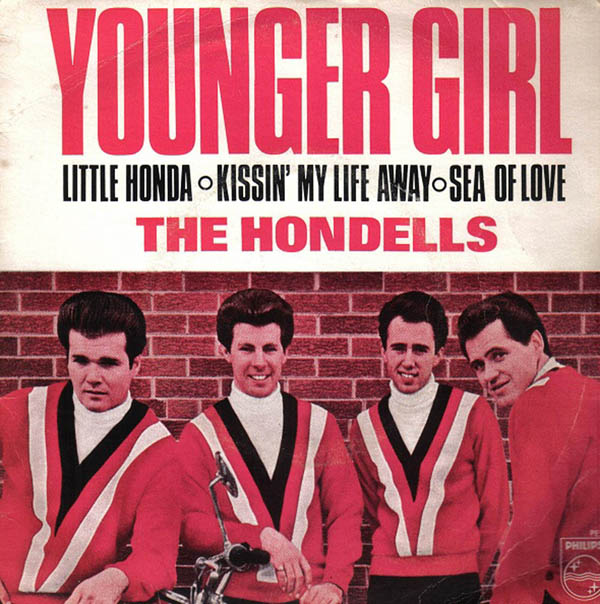
Hondells - 1967 - Younger Girl FLAC
Younger Girl/Little Honda/Kissin' My Life Away/Sea of Love
The Hondells were an American surf rock band. They are perhaps best known for their Top 10 single from 1964, a cover of the Beach Boys' "Little Honda".
The Hondells were a band manufactured by Gary Usher, originally consisting of session musicians. Their hit song, "Little Honda," was written by Brian Wilson and Mike Love of The Beach Boys. The song was inspired by the popularity of Honda motor bikes in Southern California during the early 1960s: In contrast to the prevailing negative stereotypes of motorcyclists in America as tough, antisocial rebels, Honda's campaign suggested that their motorcycles were made for everyone. The campaign was hugely successful; by the end of 1963 alone, Honda had sold 90,000 motorcycles. The Beach Boys had recorded "Little Honda" for their 1964 album All Summer Long, and subsequently producer Gary Usher gave former Castells vocalist Chuck Girard a copy of the All Summer Long LP and instructed him to learn "Little Honda."
Usher then recruited a group of studio musicians – including Glen Campbell, Al DeLory, Tommy Tedesco, Bill Cooper and Richie Podolor – (Al Ferguson) to record an album of Honda-related songs for Mercury Records, with production credited to Nick Venet, though Usher was the brains behind the record. Aside from "Little Honda," most of the songs on The Hondells' Go Little Honda album were written by Usher and KFWB disc jockey and lyricist Roger Christian. The album's cover showed a four-member group and its liner notes contained an elaborate back story, penned by Christian, which posited one Ritchie Burns as the founder and leader of the band. At the time the album was delivered, the name of the group had not been decided. Under consideration were two names: "The Rising Sons" and "The Hondells." Venet chose the latter and released "Little Honda" as a single under the new group name. As the song climbed the charts, Usher assembled a band to tour in support, and "Little Honda" eventually peaked at No. 9 on the U.S. pop singles chart.
Contrary to popular belief, session musician drummer Hal Blaine (creator of the name "The Wrecking Crew") was NOT the drummer on The Hondells' version of "Little Honda". The drummer on The Hondells' "Little Honda" was Wayne Edwards who together with Richard Burns (who played bass on the session and was cited on the album's liner notes as the band's "founder") went out on the road as part of the touring Hondells. Blaine played drums on The Super Stocks' "Little Honda" (produced by Gary Usher for Capitol) and on Pat Boone's version of the tune (produced by Terry Melcher as a single for Dot Records).
The Hondells scored another modest hit single in 1966 with a cover of the Lovin' Spoonful song "Younger Girl" (Mercury 72562) before disbanding. Randy Thomas sang the lead.
The Hondells also recorded commercials for Pepsi and Coty Cosmetics. Musicians on these recordings were Ritchie Burns, Glen Campbell, Wayne Edwards, Dennis McCarthy, Randy Thomas, who sang the lead on the Pepsi commercial and Al Ferguson who sang the lead on the Coty commercial.
Jan And Dean - 1963 - Surf City FLAC
Surf City/Honolulu Lulu/Talahassee Lassie/Soul City
While they lacked the Beach Boys' depth and capacity for artistic growth, Jan and Dean's hits from 1963 and 1964 -- which also included "The Little Old Lady (From Pasadena)," "Drag City," "Honolulu Lulu," and the mini-soap opera "Dead Man's Curve" -- are in the same class as the Beach Boys' early work in their infectious, energetic invocation of good times and California sunshine. They added an irresistibly reckless humor to the genre, and were well cast as the fun-loving hosts of the classic 1964 rock and roll hootenanny film The T.A.M.I. Show (for which they performed the rip-roaring theme, "(Here They Come) From All over the World".
All the while that Jan and Dean were recording stars and were flying around the country playing concerts on the weekends, they were both full-time college students, Dean in the school of architecture at the University of Southern California where he earned a bachelor degree in fine arts, and Jan at U.C.L.A. where he was pre-med and upon graduation he was accepted in medical school. In 1964 Jan and Dean started Majic Lamp Records. Over two years they released fourteen singles, with some of them being by Johnny Burnette, Karen Carpenter and Davy Jones of the Monkees. Dean also founded J&D Records in 1966, but it folded after two releases.
The duo's success, already on the wane a bit, was tragically cut short by Jan crash. Berry's near-fatal auto accident April1966, which had been eerily foreshadowed by the lyrics of "Dead Man's Curve." April 12, 1966 on Whittier Drive in Beverly Hills, Berry pulled out to pass a slow-moving vehicle and slammed full-speed into a truck that was unexpectedly parked at the curb. The Paramedics that arrived on the scene thought Berry was dead. Checking his vital signs, they found he was alive, and rushed him to the UCLA Hospital. There they found Jan's brain had been severely damaged and even numerous major brain surgeries could not completely repair the damage.. Not expected to live, Berry was in a coma for months and awoke unable walk, speak and was paralyzed on the right side. The name Jan & Dean remained only in the memories and record collections of their many fans for 10 years.
With Jan and Dean's career over as a result of Jan's accident, Torrence turned his attention to design, which he'd been studying at U.S.C. during Jan and Dean's recording career. Sticking to the business he knew best, Torrence opened Kittyhawk Graphics, a graphics design firm specializing in music industry design and packaging. In 1967, less than one year after Berry's accident, Kittyhawk was sharing office space with an enterprising young producer named James William Guercio, who came to Torrence with a design project. Guercio wanted Torrence to help design a logo for a new group Guercio was producing, called "Chicago Transit Authority." Using elements of the Coca-Cola logo design, Guercio and Torrence came up with a basic concept which was then given to a lettering expert to refine and complete. That logo, later shortened along with the group's name to "Chicago" was Kittyhawk's first major project.
In early 1968 Dean designed the first of over two hundred album packages to follow, "The Turtles Golden Hits." In 1969 Dean designed the first of nine covers for The Nitty Gritty Dirt Band, a relationship that continues to this day and has resulted in three Grammy Award nominations for "Best Album Cover of the Year". In addition to those nominations, Torrence won a Grammy in 1972 for "Best Album Cover of the Year" for the album Pollution by the group of the same name.
In 1969 Paul Morantz, a young law student at the University of Southern California, met Jan Berry at a resort motel in Palm Springs, California. Morantz and Berry became instant friends. After listening to some of Berry's stories, Morantz who dabbled in freelance writing, decided to write a feature story about Berry and his struggle against all odds. The story first appeared in the University of Southern California Daily Trojan in a short-edited form. Later Morantz spent many months re-writing the article for a California magazine called West. Just about the time he was putting the finishing touches on the story West stopped publishing.
By this time Morantz had graduated from law school, was busy practicing law, and the story was shelved. A couple of years later, Morantz dug out Berry's story. Re-reading it Morantz realized that the story could easily be expanded to include the whole Jan & Dean story. At this point, Morantz called Torrence and they got together to discuss what had begun to take on the proportions of a larger project. After many regular meetings and major rewriting Morantz and Torrence submitted the re-written story to Rolling Stone magazine, after it had first been turned down by all of the major general interest magazines on the ground that not enough people would remember Jan & Dean to justify its publication.
Shown from left: Bruce Davison (as Dean Torrence), Richard Hatch (as Jan Berry)
Rolling Stone accepted the story with tremendous enthusiasm, scheduling Jan & Dean to appear on their cover with the article given a major spread within. The publication date was September 12, 1974. But a funny thing happened on the way to the press, Nixon resigned and Nixon's picture pushed Jan & Dean's off the cover. But the story ran and was very well received. There seemed to be a renewed interest in Jan & Dean. Torrence and Morantz now decided that the story had all the elements of a feature film, so they started writing a screen play and started shopping the property all over town. After two years of rejections a deal was finally made with CBS to make the movie for television. Dick Clark Productions filmed "Deadman's Curve" starring Richard Hatch ("Streets of San Francisco", "Battlestar Galactica"), Bruce Davison and guest-starring Dick Clark, Wolfman Jack, Mike Love, and Bruce Johnston of the Beach Boys was started in late 1977. The very successful CBS-TV Movie "Deadman's Curve" airing in prime time nationwide in both 1978 and 1979, chronicled Berry's valiant fight to regain his ability to function normally.
With a strong will, therapy, and the support of his partner, Dean Torrence, Jan & Dean toured with the Beach Boys in 1978 and 1979. In 1986, on a friendship tour of the People's Republic of China, they were the first to be allowed to skateboard on China's Great Wall. Now celebrating more than a decade of success together with their reunion and are also celebrating over 30 years of sunshine music. Jan & Dean made a surprise guest appearance on the Vicki Lawrence Show, along with John Davidson and James Darren as Vicki's teenage heart-throbs. "The Courage of Jan Berry" aired as a feature segment on Entertainment Tonight confirming a continuous and growing career as a national concert attraction. In 1994 Jan & Dean played Three Rivers Stadium with James Brown to 45,000 fans and after 15 years, reunited with the Beach Boys at Mile High Stadium rocking 55,000 fans. Over the years, Jan and Dean have appeared at the largest stadiums as well as small county fairs. They've headlined Casinos from Las Vegas to Biloxi. They have performed at corporate parties and fraternity keggers. They have even done a few weddings and birthday parties. Jan and Dean continue to appear together, and Dean has appeared with his own band the Surf City All Stars.
Friday, 21 September 2018
The Searchers - 1965 - When You Walk In The Room FLAC
When You Walk In The Room/(I'll Be) Missing You/Someday We're Gonna Love Again/No One Else Could Love Me
"When You Walk in the Room" was recorded by The Searchers in 1964, reaching #35 in the US and #3 in the UK.
Founded in 1957 by John McNally (guitar/vocals), the Searchers were originally one of thousands of skiffle groups formed in the wake of Lonnie Donegan's success with "Rock Island Line." The Searchers' immediate competitors included bands such as the Wreckers and the Confederates, both led by Michael Pender (guitar, vocals), and the Martinis, led by Tony Jackson (guitar/vocals). By 1959, McNally and Pender were working together as a duet; later in the year, Jackson joined as the lead vocalist. After drummer Norman McGarry left the Searchers he was replaced by Chris Crummy, who quickly renamed himself Chris Curtis. Other changes were in the works as Jackson built and learned to play a customized bass guitar. Learning his new job on the four-stringed instrument proved too difficult to permit him to continue singing lead, and McNally and Pender brought in a fifth member, Johnny Sandon (born Billy Beck). Johnny Sandon & the Searchers lasted from 1960 through February of 1962, and were extremely popular on the dance hall and club circuit in Liverpool. Sandon cut out for a career on his own, with another band called the Remo Four in early 1962.
Meanwhile, the Searchers, now a quartet with Jackson once again lead singer, became one of the top acts on the Liverpool band scene, playing textured renditions of American R&B, rock & roll, country, soul, and rockabilly. The group was signed to Pye Records in mid-1963 and their first single, a cover of the Drifters' "Sweets for My Sweet," was released in August of 1963, hitting number one on the British charts. While the Beatles quickly outdistanced all comers, the Searchers did, indeed, go to the top of the charts with two of their next three singles, "Needles and Pins" and "Don't Throw Your Love Away." Another record, "Sugar and Spice," written by their producer Tony Hatch under the pseudonym Fred Nightingale, stalled at the number two spot. Over the next nine months, the band staked out a sound that was one of the most distinctive in a rock scene crawling with hundreds of bands. Their music was built around the sound of a crisply played 12-string guitar, coupled with strong lead vocals and carefully, sometimes exquisitely arranged harmonies, so that they could credibly cover American R&B standards like "Love Potion No. 9" or Phil Spector-based girl group pop like "Be My Baby." Their 1964 singles included a venture into folk-rock before the genre had been "invented" in the press, in the form of a cover of Malvina Reynolds' "What Have They Done to the Rain." Interestingly, their 12-string guitar sound would become a key ingredient in the success of the Byrds, who even took the riff from "Needles and Pins" and transformed it into the main riff of "Feel a Whole Lot Better."
In July of 1964, with the group riding the upper reaches of the British charts, and with their third album in nine months in release, it was announced that Tony Jackson was leaving the Searchers to form his own band, and would be replaced by Frank Allen, who had been playing bass with Cliff Bennett & the Rebel Rousers. The turning point for the band came in 1965, as the British and international fascination with the Liverpool sound faded away. The Searchers began casting their net wider for material to cover, in addition to coming up with one original hit, the Curtis/Pender-authored "He's Got No Love." By the beginning of 1966, the group's string of chart hits seemed to have run out, and Chris Curtis exited in early 1966, claiming to have become exhausted from the group's constant touring. The Searchers, with Johnny Blunt on drums, continued working and had their last hit, "Have You Ever Loved Somebody," which barely cracked the Top 50 in October of 1966. The group continued working, however, playing clubs and cabarets in England and Europe. Blunt exited at the end of the '60s, but was replaced by Billy Adamson, and this lineup of the Searchers continued intact until the mid-'80s, working for 35 weeks a year throughout Europe with an occasional U.S. visit. Although they played as part of Richard Nader's "Rock 'n Roll Revival" shows, they never became an "oldies" act, always adding new material, including originals and covers of work by songwriters such as Neil Young to their sets, and in 1972, the band cut an album for British RCA.
The Searchers At the end of the '70s, their recording fortunes were revived once again as Seymour Stein, the head of Sire Records, signed the Searchers for two albums. Those records, The Searchers and Love's Melodies, were the best work the group ever did, highlighted by achingly beautiful yet vibrant and forceful playing and singing, and an unerring array of memorable hooks and melodies. Those two albums were followed by a series of tracks recorded for their original label, Pye Records, in the early '80s. The group held their audience well into the '80s, playing before crowds as large as 15,000 along one U.S. tour. In 1985, after playing together for 26 years, Pender and McNally split up, with McNally continuing to lead the Searchers (with Adamson and Allen, and with Spencer James added on second guitar and vocals), while Pender formed Mike Pender's Searchers, consisting of Chris Black (guitar, vocals), Barry Cowell (bass, vocals), and Steve Carlyle (drums, vocals). The Searchers under McNally recorded on occasion, releasing their last album, Hungry Hearts, in 1989. The two versions of the Searchers toured extensively into the 2010s, both featuring shifting lineups.
Thursday, 20 September 2018
The Marketts - 1963 - Surfin' @320
Surfin'/Stomp, Look And Listen/Stompin' Room Only/Stompede
The Marketts were an American instrumental pop group, formed in January 1961 in Hollywood, California, by Michael Z. Gordon. They are best known for their 1963 million-seller, "Out of Limits".
The Marketts' line-up featured Michael Z. Gordon and various session musicians from the Los Angeles area, including drummer Hal Blaine. The group name was originally spelled "Mar-Kets". The group's direction was spearheaded by producer Joe Saraceno and Michael Z. Gordon, although Saraceno could not arrange or play on any of the group's material. Gordon's songs which were composed for the Marketts are best remembered for their surf rock sound, though not all of their material has this sound; Gordon took the group's style in whatever direction he thought would catch the record-buying public's ear. In the U.S., the group had three Top 40 hits and had two popular albums, many of the songs composed by Gordon.
The Marketts' surfer sound started with "Surfer's Stomp", which was by written by and produced by Gordon and Saraceno. Gordon also wrote their biggest hit, "Out of Limits", which was originally entitled "Outer Limits", named after the 1963 TV series The Outer Limits. Rod Serling sued the Marketts for quoting the four-note motif from his television show, The Twilight Zone, without his approval, which resulted in the change of the title to "Out of Limits". It reached No. 3 on the Billboard Hot 100 chart in 1964. It sold over one million copies, and was awarded a gold disc. The band name was used as late as 1977 for further releases, though their last hit came in 1966.
Johnny Cash - 1965 - Come In Stranger FLAC
Come In Stranger/The Ways Of A Woman In Love/Guess Things Happen That Way/Ballad Of A Teenage Queen
"Guess Things Happen That Way" is a 1958 cross over single by Johnny Cash, which was written by Jack Clement. The single, a song about "a man struggling ... after the love of his life has left him", was Johnny Cash's fourth number one on the country chart spending eight weeks at number one and a total of twenty-four weeks on the chart. The B-side of "Guess Things Happen That Way", a song entitled, "Come In Stranger" made it to number six on the country chart. The single also crossed over to the pop chart, peaking at number eleven.
"Ballad of a Teenage Queen" is a song written by Jack Clement and recorded by Johnny Cash for his 1958 album Sings the Songs That Made Him Famous. The song hit number one on the US Country charts and number 14 on the Billboard Hot 100. The song is 2 minutes and 13 seconds long.The song tells the story of a "small town girl" (the prettiest they've ever seen) who loved the boy next door (who worked at the candy store). She was taken to Hollywood by a movie scout where she became famous, leaving the boy. Eventually she sold all her fame to go back to the boy from the candy store because amid it all she was unhappy without him.
"The Ways of a Woman in Love" released in 1958 made it to number 2 on the US Country Charts number 24 on the Billboard Top 100 and number 28 on he Australian Charts.
Wednesday, 19 September 2018
Tommy Boyce and Bobby Hart - 1968 - I Wonder What She's Doing Tonight FLAC
I Wonder What She's Doing Tonight/The Ambushers/My Little Chickadee/Sometimes She's A Little Girl
"I Wonder What She's Doing Tonight" is a song written, produced, and sung by Boyce and Hart. The song was arranged by Artie Butler. Entering the Billboard Hot 100 at #87 just before Christmas 1967, it became a true hit in 1968, reaching #7 on the Cash Box chart and #8 on the Billboard Hot 100 chart. The song features a trumpet solo by Marvin Stamm. The song also features the voice of Tommy Boyce, quickly saying to Bobby Hart, before the third verse, "All right, Bobby, let's go."
Boyce & Hart, best known as frequent songwriters for the Monkees, were among the more successful West Coast pop/rock composers of the late '60s, also landing some material with other artists and making some records of their own, including the hit "I Wonder What She's Doing Tonight."
Tuesday, 18 September 2018
Gerry And The Pacemakers - 1965 - Ferry Cross The Mersey FLAC
It's Gonna Be All Right/ I'll Wait For You/Why Oh Why/Ferry Cross The Mersey
"Ferry Cross the Mersey" (sometimes written Ferry 'Cross the Mersey) is a song written by Gerry Marsden. It was first recorded by his band Gerry and the Pacemakers and released in late 1964 in the UK and in 1965 in the United States. It was a hit on both sides of the Atlantic, reaching number six in the United States number eight in the UK and number 45 in Australia. The song is from the film of the same name and was released on its soundtrack album. In the mid-1990s a musical theatre production also titled Ferry Cross the Mersey related Gerry Marsden's Merseybeat days; it premiered in Liverpool and played in the UK, Australia, and Canada.
In May 1989, a charity version of "Ferry Cross the Mersey" was released in aid of those affected by the Hillsborough disaster, which claimed the lives of 95 Liverpool fans the previous month (a 96th, Tony Bland, died in 1993 as a consequence of that disaster). The song was recorded by Liverpool artists The Christians, Holly Johnson, Paul McCartney, Gerry Marsden and Stock Aitken Waterman. The single held the #1 spot in the UK chart for three weeks and the Irish chart for two weeks.
Subscribe to:
Posts (Atom)