Saturday, 15 April 2017
Who - 1967 - Dance Sessions FLAC
The Kids Are Alright/It's Not True/ A Legal Matter/La-La-La Lies
The Who are an English rock band that formed in 1964. Their classic line-up consisted of lead singer Roger Daltrey, guitarist and singer Pete Townshend, bass guitarist John Entwistle, and drummer Keith Moon. They are considered one of the most influential rock bands of the 20th century, selling over 100 million records worldwide and holding a reputation for their live shows and studio work.
The Who developed from an earlier group, the Detours, and established themselves as part of the pop art and mod movements, featuring auto-destructive art by destroying guitars and drums on stage. Their first single as the Who, "I Can't Explain", reached the UK top ten, followed by a string of singles including "My Generation", "Substitute" and "Happy Jack". In 1967, they performed at the Monterey Pop Festival and released the US top ten single "I Can See for Miles", while touring extensively. The group's fourth album, 1969's rock opera Tommy, included the single "Pinball Wizard" and was a critical and commercial success. Live appearances at Woodstock and the Isle of Wight Festival, along with the live album Live at Leeds, cemented their reputation as a respected rock act. With their success came increased pressure on lead songwriter and visionary Townshend, and the follow-up to Tommy, Lifehouse, was abandoned. Songs from the project made up 1971's Who's Next, which included the hit "Won't Get Fooled Again". The group released the album Quadrophenia in 1973 as a celebration of their mod roots, and oversaw the film adaptation of Tommy in 1975. They continued to tour to large audiences before semi-retiring from live performances at the end of 1976. The release of Who Are You in 1978 was overshadowed by the death of Moon shortly after.
Kenney Jones replaced Moon and the group resumed activity, releasing a film adaptation of Quadrophenia and the retrospective documentary The Kids Are Alright. After Townshend became weary of touring, the group split in 1982. The Who occasionally re-formed for live appearances such as Live Aid in 1985, a 25th anniversary tour in 1989 and a tour of Quadrophenia in 1996–1997. They resumed regular touring in 1999, with drummer Zak Starkey. After Entwistle's death in 2002, plans for a new album were delayed. Townshend and Daltrey continued as the Who, releasing Endless Wire in 2006, and continued to play live regularly.
The Who's major contributions to rock music include the development of the Marshall stack, large PA systems, use of the synthesizer, Entwistle and Moon's lead playing styles, Townshend's feedback and power chord guitar technique, and the development of the rock opera. They are cited as an influence by hard rock, punk rock and mod bands, and their songs still receive regular exposure.
Thanks To Mr. Purser
Kinks - 1968 - The Kinks
David Watts/Two Sisters/Lazy Old Sun/Situation Vacant
The Kinks were an English rock band formed in Muswell Hill, North London, in 1964 by brothers Ray and Dave Davies. They are regarded as one of the most important and influential rock bands of the era. The band emerged during the height of British rhythm and blues and Merseybeat, and were briefly part of the British Invasion of the US until their touring ban in 1965. Their third single, the Ray Davies-penned "You Really Got Me", became an international hit, topping the charts in the United Kingdom and reaching the Top 10 in the United States. Between the mid-1960s and early 1970s, the group released a string of hit singles; studio albums drew good reviews but sold less than compilations of their singles. Their music was influenced by a wide range of genres, including rhythm and blues, British music hall, folk and country. They gained a reputation for reflecting English culture and lifestyle, fuelled by Ray Davies' observational writing style. Albums such as Something Else (1967), The Kinks Are the Village Green Preservation Society (1968), Arthur (1969), Lola Versus Powerman (1970), along with their accompanying singles, are considered among the most influential recordings of the period.
After a fallow period in the mid-1970s, the band experienced a revival during the late 1970s and early 1980s with albums Sleepwalker, Misfits, Low Budget, Give the People What They Want and State of Confusion. In addition, groups such as Van Halen, the Jam, the Knack, the Pretenders and the Fall covered their songs, helping to boost the Kinks' record sales. In the 1990s, Britpop acts such as Blur and Oasis cited the band as a major influence. The Kinks broke up in 1996, a result of the commercial failures of their last few albums and creative tension between the Davies brothers. Ray Davies (lead vocals, rhythm guitar) and Dave Davies (lead guitar, vocals) remained members throughout the group's 32-year run. Longest-serving member Mick Avory (drums and percussion) was replaced by Bob Henrit, formerly of Argent, in 1984. Original bassist Pete Quaife was replaced by John Dalton in 1969, and Dalton was in turn replaced by Jim Rodford in 1978. Session keyboardist Nicky Hopkins accompanied the band in the studio for many of their recordings in the mid-to-late 1960s. In 1969 the band became an official five-piece when keyboardist John Gosling joined them, being replaced by Ian Gibbons in 1979, who remained in the band until they broke up in 1996.
The group had five Top 10 singles on the US Billboard chart. Nine of their albums charted in the Top 40. In the UK, the group had seventeen Top 20 singles and five Top 10 albums. Four of their albums have been certified gold by the RIAA and have gone on to sell over 50 million albums worldwide. Among numerous honours, they received the Ivor Novello Award for "Outstanding Service to British Music". In 1990, the original four members of the Kinks were inducted into the Rock and Roll Hall of Fame, as well as the UK Music Hall of Fame in November 2005.
Sunday, 9 April 2017
Bobby Darin - 1967 - If I Were A Carpenter
If I Were A Carpenter/Rainin'/The Ballad of Cat Ballou/The Sweetheart Tree
If I Were a Carpenter is an album by American singer Bobby Darin, released in 1966. It was a significant change in direction for Darin considering his previous album (In a Broadway Bag) was a collection of show tunes.
Having previously built his career recording mainstream pop music, Darin's musical output became more "folky" as the 1960s progressed. In 1966, he charted with folksinger Tim Hardin's "If I Were a Carpenter". It was Darin's return to the Top 10 after a four-year absence (the single peaked at No. 8 in the US and No. 9 in the UK in 1966). The tracks leaned heavily towards songs by Hardin and John Sebastian — seven of the songs were written by these two songwriters and Darin's next album would follow a similar process. The song "Red Balloon" had not yet been released by Hardin. It would appear on his album 1967 album Tim Hardin 2. In his Allmusic review, Richie Unterberger, stated "Hardin himself was convinced that Darin had copied his vocal style by listening to his yet-to-be-issued version and the album as a whole boasts a production similar to the orchestrated folk-rock heard on the debut album in question, though it sounds like an inferior copy." Both Darin's If I Were a Carpenter and Hardin's Tim Hardin 2 were produced by Charles Koppelman and Don Rubin and Koppelman had originally signed Sebastian's band, The Lovin' Spoonful.
The album reached number 142 on the Billboard Pop Albums chart. Darin's cover of "Lovin' You" reached the Top 40. If I Were a Carpenter was reissued in 1998 on the Diablo label combined with Darin's next release, Inside Out.
Monday, 3 April 2017
Solomon Bourke - 1968 - Detroit City FLAC
Detroit City/It's Been A Change/Take Me (Just As I Am)/I Stayed Away Too Long
Soul-R&B pioneer Solomon Burke never gained the level of fame afforded to contemporaries James Brown, Al Green, Wilson Pickett, Otis Redding, or Sam Cooke. Rather, artists such as the Rolling Stones, Otis Redding, and the Blues Brothers introduced him to a wider audience through their cover versions.
The Stones’ early versions of “Cry to Me” and “Everybody Needs Somebody to Love” especially stand out. In fact, the former appeared over 20 years later in the 1987 blockbuster Dirty Dancing, garnering renewed interest in the singer.
Born above Philadelphia’s Solomon’s Temple church, Burke was an ordained minister throughout his life as well as a mortician. He certainly led a very colorful life, as evidenced by a revealing Rolling Stone profile. Always full of life, the singer never actually slowed down even in the face of obvious weight gain and immobility, recording, touring, and often preaching from the pulpit of his Los Angeles church, the House of Prayer for All People and World Wide Center for Life and Truth (the church must have a wide sign). He passed away suddenly on Oct. 10, 2010, of natural causes after arriving in Switzerland by jet for a live performance with Dutch rock band De Dijk. Hold on Tight, a final, collaborative studio album featuring the decidedly odd couple, was ultimately released one year later.
In his 70 years on Earth, Burke wrote many songs and had his fair share of hits, albeit unfairly relegated to the R&B charts. Critics and soul aficionados have regularly called Burke one of the greatest singers of his generation, dubbing him “The King of Rock & Soul.” Burke’s vocals always possessed a ‘You’ve got to be born with ‘em’ gospel undertone. Even on soul numbers like “I Feel a Sin Coming On” and “Meet Me in Church,” the listener feels as if they’re hearing a gospel song straight from the Lord’s altar.
Burke wasn’t strictly pigeon-holed as a soul music interpreter. During his early Atlantic years, the singer was usually backed by a full orchestra with a decidedly pop sound, vocally resembling Sam Cooke on his first Atlantic single in 1961, the non-charting, yet very charming “Keep the Magic Working.” Burke was a masterful interpreter of pop standards, including one of his most neglected performances, a 1969 rendition of “That Lucky Old Sun,” which idiosyncratic Beach Boys founder Brian Wilson revived almost 40 years later.
Though not well-known as a social protest singer, Burke still left his mark with versions of “I Wish I Knew (How It Would Feel to Be Free)” and Elvis Presley’s “In the Ghetto.” And as soon as he began recording, Burke set himself apart from his peers by tackling country standards, including “I Really Don’t Want to Know,” “He’ll Have to Go,” “Detroit City,” and “We’re Gonna Hold On,” the latter taken from the appropriately titled Nashville released late in the artist’s career. Burke’s early forays into country triumphantly bridged the gap between segregated audiences months before Ray Charles’ much more successful versions of “I Can’t Stop Loving You” and “You Don’t Know Me.”
By the early ’70s, Burke was having few and far in-between hits, bouncing from one record label to the next. As the mid-‘80s rolled around, King Solomon found himself attached to Rounder Records, releasing the critically-acclaimed A Change Is Gonna Come. Subsequent years found the singer devoting much of his time to constant touring to make ends meet. By 2002, a sustaining comeback finally occurred, as Don’t Give Up on Me won a Grammy for Best Contemporary Blues Album. The long-running CBS television procedural Cold Case showcased one track from that great album in a 2008 episode, the sparse social commentary “None of Us Are Free.”
Artists such as Eric Clapton, Bob Dylan, Bruce Springsteen, to producers ranging from Don Was and Willie Mitchell, all contributed songs to Burke’s 21st century discography. Burke’s penultimate album, Nothing’s Impossible, was the epitaph for producer Willie Mitchell, and it also serves as a fitting almost-finale for Burke. Listen to the opening song, “Oh What a Feeling,” cut in Memphis at Royal Studios with Mitchell’s trademark strings, organ, and rich rhythm section anchoring Burke’s longing vocals.
Sixty-eight years old when that performance was tracked, Burke’s singing had lost nothing with the passage of time. When he moans, almost preaching the lines “One night’s sleep is never enough, it feels so good, I don’t wanna wake up, oh what a feeling, I can’t help myself, I’ve just got, what a feeling I have inside for you,” you know he’s singing from plenty of hard-earned experience.
Del Shannon - 1965 - Del Shannon Hits FLAC
Stranger In Town/Do You Wanna Dance/Keep Searchin' (Follow The Sun)/Handy Man
One of the best and most original rockers of the early '60s, Del Shannon was also one of the least typical. Although classified at times as a teen idol, he favored brooding themes of abandonment, loss, and rejection. In some respects he looked forward to the British Invasion with his frequent use of minor chords and his ability to write most of his own material. In fact, Shannon was able to keep going strong for a year or two into the British Invasion, and never stopped trying to play original music, though his commercial prospects pretty much died after the mid-'60s.
Born Charles Westover, Shannon happened upon a gripping series of minor chords while playing with his band in Battle Creek, MI. The chords would form the basis for his 1961 debut single, "Runaway," one of the greatest hits of the early '60s, with its unforgettable riffs, Shannon's amazing vocal range (which often glided off into a powerful falsetto), and the creepy, futuristic organ solo in the middle. It made number one, and the similar follow-up, "Hats Off to Larry," also made the Top Ten.
Shannon had intermittent minor hits over the next couple of years ("Little Town Flirt" was the biggest), but was even more successful in England, where he was huge. On one of his European tours in 1963, he played some shows with the Beatles, who had just scored their first big British hits. Shannon, impressed by what he heard, would become the first American artist to cover a Beatles song when he recorded "From Me to You" for a 1963 single (although it would give him only a very small hit). Shannon's melodic style had some similarities with the burgeoning pop/rock wing of the British Invasion, and in 1965, Peter & Gordon would cover a Shannon composition, "I Go to Pieces," for a Top Ten hit.
Del got into the Top Ten with a late-1964 single, "Keep Searchin'," that was one of his best and hardest-rocking outings. But after the similar "Stranger in Town" (number 30, 1965), he wouldn't enter the Top 40 again for nearly a couple of decades. A switch to a bigger label (Liberty) didn't bring the expected commercial results, although he was continuing to release quality singles. Part of the problem was that some of these were a bit too eager to recycle some of his stock minor-keyed riffs, as good as his prototype was. A brief association with producer Andrew Loog Oldham (also manager/producer of the Rolling Stones) found him continuing to evolve, developing a more Baroque, orchestrated pop/rock sound, and employing British session musicians such as Nicky Hopkins. Much to Shannon's frustration, Liberty decided not to release the album that resulted from the collaboration (some of the material appeared on singles, and much of the rest of the sessions would eventually be issued for the collector market).
By the late '60s, Shannon was devoting much of his energy to producing other artists, most notably Smith and Brian Hyland. Shannon was a perennially popular artist on the oldies circuit (particularly in Europe, where he had an especially devoted audience), and was always up for a comeback attempt on record. Sessions with Jeff Lynne and Dave Edmunds in the '70s didn't amount to much, but an early-'80s album produced by Tom Petty (and featuring members of the Heartbreakers as backing musicians) got him into the Top 40 again with a cover of "Sea of Love." He was working on another comeback album with Jeff Lynne, and sometimes rumored as a replacement for Roy Orbison in the Traveling Wilburys, when he unexpectedly killed himself on February 8, 1990, while on anti-depressant drugs.
Sunday, 2 April 2017
Mary Hopkin - 1972 - Mary
Goodbye/Those Were The Days/Water, Paper And Clay/Knock Knock Who's There
Mary's story has been told many times over. At some point we may write a sheer unadulterated biography for this website, but for now, here are the basics, pulled from Wikipedia:
Mary Hopkin (born May 3, 1950) is a Welsh folk singer. She is best known as one of the first artists to sign to The Beatles' Apple Records label.
Alongside playing solo gigs and with her band around the local clubs, Mary released an album of Welsh language songs on a label called Cambrian who were based in her home town of Pontardawe, before signing to the Beatles' Apple Records. The model Twiggy saw her winning the British ITV television talent show Opportunity Knocks and recommended her to Paul McCartney. She became one of the first artists to record on The Beatles' Apple record label.
Mary's debut single, 'Those Were the Days', produced by Paul McCartney, was released in the UK on August 30, 1968. On 21 February 1969 her debut album, 'Postcard', also produced by McCartney, was released.
She represented the United Kingdom in the 1970 Eurovision Song Contest singing 'Knock Knock, Who's There?', coming second in the competition. If you mention Eurovision to Mary now, she pulls a disgusted face, not because she came second, but because this represents the pinnacle of the sugary sweet pop world that she hated.
Her second album, 'Earth Song, Ocean Song', was released by Apple on October 1, 1971. The record was produced by Tony Visconti and included cover versions of songs written by Cat Stevens, Gallagher and Lyle, and Ralph McTell. This is by far Mary's favourite album and she regrets being unable to promote it properly, being tied up in a summer season. Her Apple releases have now been remastered and are available on CD and downloads.
After marrying Visconti in 1971, Hopkin withdrew from the pop music scene to have a family. Delaney (who changed his name to Morgan) was born in 1972 and Jessica in 1976. Although reportedly unhappy with show business, Hopkin did not stop recording. She travelled to Australia with Visconti in January 1972 and performed at a large outdoor rock festival in South Australia, as well as giving concerts in several major cities. With the help of Visconti, 1972 saw the release of the Christmas songs 'Mary Had a Baby'/'Cherry Tree Carol' on Regal Zonophone Records, which was re-released in 1973. These have been released on CD by Mary Hopkin Music (that's us) in 2008.
She was in a band called Sundance with Mike Hurst and Mike de Albuquerque of ELO, and then she made an album with the original band called Oasis (nothing to do with those naughty brothers) which also featured Julian Lloyd Webber and Peter Skellern. In 1989 she recorded "Spirit" with Benny Gallagher. Now being re-released on MHM.
Lots of recording projects over the years kept Mary as busy as she wants to be, and none of them were ever intended as a "comeback", although this is tends to be what happens.
Her daughter, Jessica Morgan, released 'Live at the Royal Festival Hall 1972' in 2005 under the label Mary Hopkin Music. When Jessica opened Space Studios later that year with her partner Christian Thomas (the other one, not the Pink Floyd record producer), Mary Hopkin Music was incorporated into the studio which now provides a haven where Mary can record. The discovery of yet more unreleased tracks recorded with Tony Visconti has led to our release of the "Archive" albums on Mary Hopkin Music. Additionally, Mary has since found a huge stash of other songs written by herself. We are working on releasing these too.
Mary lives a nomadic lifestyle, flitting about between countries. Rumour has it that she lives in a chateau in France where she can only be reached by carrier pigeon. While not strictly true, she still values her privacy.
Nancy Sinatra - 1967 - Summer Wine FLAC
Summer Wine/Shades/I Can't Grow Peaches On A Cherry Tree/The More I See You
"Summer Wine" is a song written by Lee Hazlewood. It was originally sung by Suzi Jane Hokom and Lee Hazlewood in 1966, but it was made famous by Nancy Sinatra and Lee Hazlewood in 1967. This version was originally released as the B-side of "Sugar Town" the previous year, before featuring on the Nancy & Lee LP in 1968. It was the first of Sinatra and Hazlewood's string of popular duets.
Lyrically, "Summer Wine" describes a man, voiced by Hazlewood, who meets a woman, Sinatra, who notices his silver spurs and invites him to have wine with her. After heavy drinking, the man awakens hungover to find his spurs and money have been stolen by the mysterious woman; the subtext of which being they experienced intercourse and as payment she took his "silver spurs, a dollar and a dime". He then declares a longing for more of her "wine". One interpretation is that the man singing the song was seduced by the woman in order to steal his money and belongings. Another interpretation, sometimes cited, is that the song contains an allegorical description of drug use and that the lyric "she reassured me with an unfamiliar line" specifically refers to cocaine though that is anomalous for the apparent period setting. Thanks to Sunshine
T Rex - 1978 - T Rex FLAC
Get it On (Bang a Gong)/Hot Love/Debora/Ride a White Swan
T. Rex were an English rock band, formed in 1967 by singer-songwriter and guitarist Marc Bolan. The band was initially called Tyrannosaurus Rex, and released four psychedelic folk albums under this name. In 1969, Bolan began to shift from the band's early acoustic sound to an electric one. The following year, he shortened their name to T. Rex. The 1970 release of the single "Ride a White Swan" marked the culmination of this development, and the group soon became a commercial success as part of the emerging glam rock scene.
From 1970 until 1973, T. Rex encountered a popularity in the UK comparable to that of the Beatles, with a run of eleven singles in the UK top ten. One of the most prominent acts in British popular culture, they scored four UK number one hits, "Hot Love", "Get It On", "Telegram Sam" and "Metal Guru". The band's 1971 album Electric Warrior received critical acclaim as a pioneering glam rock album. It reached number 1 in the UK. The 1972 follow-up, The Slider, entered the top 20 in the US. Following the release of "20th Century Boy" in 1973, which reached number three in the UK, T. Rex began to experience less commercial success but continued recording one album per year.
In 1977, Bolan died in a car accident several months after releasing their final studio album Dandy in the Underworld. Since then, T. Rex have continued to exert a vast influence on a variety of subsequent artists.
Friday, 31 March 2017
Gary Puckett & The Union Gap - 1969 - Lady Willpower
Lady Willpower/Daylight Stranger/Over You/If The Day Would Come
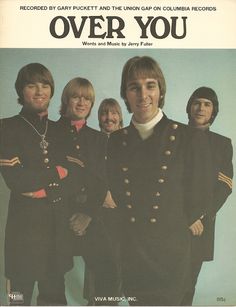
Gary Puckett & The Union Gap (initially credited as The Union Gap featuring Gary Puckett) was an American pop rock group active in the late 1960s. Their biggest hits were "Woman, Woman"; "Over You"; "Young Girl"; and "Lady Willpower." It was formed by Gary Puckett, Gary 'Mutha' Withem, Dwight Bement, Kerry Chater, and Paul Wheatbread, who eventually named it The Union Gap. It featured costumes that were based on the Union Army uniforms worn during the American Civil War. They were noticed by Jerry Fuller, who gave them a recording contract with Columbia Records. The group eventually grew unhappy with doing material written and produced by other people, leading them to stop working with Fuller. The band eventually disbanded and Puckett went on to do both solo work and collaborations.
"Lady Willpower" is a song written by Jerry Fuller and recorded by Gary Puckett & The Union Gap for their 1968 album, Incredible. It is sung from the point of view of a man who is frustrated that the woman he is seeing will not agree to have sex with him. He promises, if she complies, to "shower [her] heart with tenderness," but it is also implicit that the relationship will end ("It's now or never") if she does not. The song hit #1 on the Cash Box Top 100 and #2 on the Billboard Hot 100 in 1968. It also reached #5 on the UK Singles Chart during the year. The single was awarded a million-selling Gold disc from the RIAA. It ranked among Cash Box magazine's Top 100 singles of 1968, where it hit the #1 position the week ending August 3, 1968. The song was the #34 song on the Billboard Year-End Hot 100 singles in 1968
"Over You" is a hit song written by Jerry Fuller and recorded by Gary Puckett & The Union Gap for their 1968 album, Incredible. The song reached #3 on the Adult Contemporary chart. It peaked at #5 in Cash Box as well as #7 on the Billboard Hot 100 chart in late 1968. This cut was the group's fourth consecutive million-selling Gold-certified single produced and written by Jerry Fuller. It received a Gold disc from the RIAA in December 1968. The song was an international success, reaching #3 in Canada, #6 in Australia, and #17 in New Zealand. It ranked #41 on the US Cashbox chart Top 100 Hits of 1968.
Billy J. Kramer - 1964 - Little Children FLAC
Little Children/They Remind Me Of You/Beautiful Dreamer/ I Call Your Name
One of the most popular Merseybeat singers, Billy J. Kramer (born Billy Ashton) was one of the most mild-mannered rockers of the entire British Invasion. He wasn't that noteworthy a singer, either, and more likely than not would have never been heard outside of northern England if he hadn't been fortunate enough to become a client of Beatles manager Brian Epstein. Even more crucially, he was gifted with several Lennon-McCartney songs in 1963 and 1964, several of which the Beatles never ended up recording. That gave him his entrance into the charts on both sides of the Atlantic, but Kramer couldn't sustain his success after the supply of Lennon-McCartney tunes dried up. Significant? No. Enjoyable? Yes. Even tossing aside the considerable value of hearing otherwise unavailable Lennon-McCartney compositions, his best singles were enjoyably wimpy, melodic pop/rock, offering a guilty pleasure comparable to taking a break from Faulkner and diving into some superhero comics.
It's been reported that George Martin was reluctant to produce Kramer because of the latter's vocal deficiencies, making sure to hide the cracks in his upper register with loud piano notes in Billy's cover of "Do You Want to Know a Secret." No matter -- the song made it to number two in the U.K. in mid-1963, followed by another Lennon-McCartney effort, "Bad to Me." "I'll Keep You Satisfied" and "From a Window" were other gifts from the Beatles camp that gave Kramer solid hits; one Beatles reject, "I'll Be on My Way," was even relegated to a B-side (the Beatles' own BBC version was finally released in 1994). All these tunes, it should be noted, represented Lennon-McCartney at their lightest and most facile, which to a large degree explains why they didn't record the numbers for their own releases, deeming them more suitable for Kramer's fairly bland approach.

Billy J. actually landed his biggest hit, the corny pop ballad "Little Children," without assistance from his benefactors; the single also broke him, briefly, as a star in the United States, where it and its flip side ("Bad to Me") both made the Top Ten. He appeared in the legendary 1964 The T.A.M.I. Show rockumentary film, and the Dakotas recorded some instrumental rock on their own, getting a Top 20 British hit with the Ventures-ish "The Cruel Sea." Early British guitar hero Mick Green, formerly with Johnny Kidd & the Pirates, was even a Dakota briefly. But after 1965's cover of Bacharach-David's "Trains and Boats and Planes," the hits ceased, as the Beatles and Epstein's attention was lost. Kramer continued recording throughout the '60s, even briefly venturing into hard psychedelic-tinged rock, without much success, and subsequently toured often on the oldies circuit.
"Little Children" is a song written by J. Leslie McFarland and Mort Shuman. It was recorded by Billy J. Kramer & the Dakotas, and reached number one in the UK Singles Chart in March 1964, and No. 7 in the US Hot 100 singles chart later the same year. The B-side of "Little Children" in the U.S., "Bad to Me" (which had previously been an A-side in the UK which made No. 1 there in August 1963) peaked at No. 9 on the US charts simultaneously to the success of "Little Children" there.
Thursday, 30 March 2017
P.J. Proby - 1965 - The Hit Sound Of P.J. Proby FLAC
Somewhere/I Apologise/ Together/Hold Me
P.J. Proby (born James Marcus Smith, November 6, 1938) is an American singer, songwriter, and actor. He has also portrayed Elvis Presley and Roy Orbison in musical theater productions. The stage name P.J. Proby was suggested by a friend, Sharon Sheeley, who had a boyfriend of that name at high school.
Proby recorded the singles "Hold Me", "Somewhere" and "Maria". In 2008, he turned 70 and EMI released the Best of the EMI Years 1961–1972. He still writes and records on his own independent record label, Select Records, and performs in the UK in Sixties concerts.
Proby was born in Houston, Texas, United States, and educated at San Marcos Military Academy, Culver Naval Academy and Western Military Academy. After graduation he moved to California to become a film actor and recording artist. Given the stage name Jett Powers by Hollywood agents Gabey, Lutz, Heller and Loeb, he took acting and singing lessons and played small roles in films. Two singles, "Go, Girl, Go" and "Loud Perfume" appeared on an independent label. Proby was brought by Sharon Sheeley to audition at Liberty Records in 1961 and he recorded a number of unsuccessful singles. In 1962 he began writing songs and recording demos for artists such as Elvis Presley and Bobby Vee.
Success in Britain
Proby travelled to London after being introduced to Jack Good by Sheeley and Jackie DeShannon. He appeared on The Beatles' television special in 1964. Under Good, Proby had UK top 20 hits in 1964 and 1965 including "Hold Me" (UK No.3), "Together" (UK No.8, featuring guitarists Big Jim Sullivan and Jimmy Page), "Somewhere" (UK No.6) and "Maria" (UK No.8); the latter two songs were both lifted from the musical West Side Story. He also recorded the Lennon–McCartney composition "That Means a Lot", a song The Beatles attempted to record before giving it away.
Proby's UK career lost momentum after controversial live concert appearances including two trouser-splitting incidents at shows in Croydon and Luton in January 1965 that scandalized the British press and public and led to bans on Proby appearances by the ABC theatre chain, its TV namesake and BBC TV. Minor hits in 1966 were followed by flops, and in March 1968 "It's Your Day Today" gave Proby his last UK chart entry for nearly 30 years.[citation needed]
Back in the U.S.
In 1967 Proby scored his only Billboard Hot 100 Top 30 hit with "Niki Hoeky". In September 1968, he recorded Three Week Hero, released in 1969. A collection of country-style ballads mixed with blues, it used The New Yardbirds, later to become Led Zeppelin, as backing band. The album was produced by Steve Rowland.
Cilla Black - 1969 - Step Inside Love FLAC
Step Inside Love/Words/Aquarius/Surround Yourself With Sorrow
"Step Inside Love" is a song written by Paul McCartney (credited as "Lennon–McCartney") for Cilla Black in 1967 as a theme for her TV series Cilla, which first aired on 30 January 1968.
In late 1967 McCartney was approached to write the theme by Cilla and her series producer Michael Hurll. He recorded the original demo version at his London home, accompanying himself on guitar, which consisted of just one verse and the chorus.
Black's recording of this song was used as the theme during the early weeks of the show, until it was decided that the song needed an additional verse, so McCartney came to the BBC Theatre and wrote it there. According to Hurll, the opening line of the second verse ("You look tired, love") came from McCartney's observation of Cilla looking tired from the long rehearsals for the TV show. McCartney then added a third verse and this version was recorded as a studio demo at Chappell Studios in London on 21 November 1967, with McCartney on guitar accompanying Cilla on vocals. This demo was the basis for the single, although where the McCartney demos were recorded in the key of D, the final arrangement of the single version was transposed up a fourth to G, to take advantage of Cilla's higher register.
The single version of the song (with Cilla singing live over the studio backing track) was premiered on 5 March 1968 edition of her show; the single was released on 8 March 1968, and reached number eight on the British charts in April 1968. The record also reached Number 15 in Ireland in the same month. The recording was also featured on Black's third solo studio album Sher-oo!
Surround Yourself with Cilla is the title of Cilla Black's fourth solo studio album released on 23 May 1969 by Parlophone Records. It was Cilla's first album to only be recorded and released in stereo sound format, and her first to fail to make the UK charts.
The album title was inspired by the lead single "Surround Yourself with Sorrow" which had previously reached #3 on the UK Singles Chart. An Italian language version of this song "Quando Si Spezza Un Grande Amore", with Italian lyrics by Mogal, was also recorded for the Latin market, while a Swedish language version "Försök och sov på saken"
"Medley: Aquarius/Let the Sunshine In (The Flesh Failures)" (commonly called "Aquarius/Let the Sunshine In", "The Age of Aquarius" or "Let the Sunshine In") is a medley of two songs written for the 1967 musical Hair by James Rado & Gerome Ragni (lyrics), and Galt MacDermot (music) Cilla Black recorded the song for her 1969 studio album Surround Yourself with Cilla.
"Words" is a song by the Bee Gees, written by Barry, Robin & Maurice Gibb recorded by Cilla Black for her album Surround Yourself with Cilla
Wednesday, 1 March 2017
Ro!!ing St0nes - 1967 - Ruby Tuesd@y
Have You Seen Your Mother Baby, Standing In The Shadow/Paint It Black/Let's Spend the Night Together/Ruby Tuesday
The Rolling Stones are an English rock band formed in London in 1962. The original line-up consisted of Brian Jones (rhythm guitar, harmonica), Mick Jagger (lead vocals), Keith Richards (lead guitar, backing vocals), Ian Stewart (piano), Bill Wyman (bass), and Charlie Watts (drums). Stewart was removed from the official line-up in 1963 but continued as a touring member until his death in 1985. Jones left the band less than a month prior to his death in 1969, having already been replaced by Mick Taylor, who remained until 1974. After Taylor left the band, Ronnie Wood took his place in 1975 and has been on guitar in tandem with Richards ever since. Following Wyman's departure in 1993, Darryl Jones joined as their touring bassist. Other touring keyboardists for the band have been Nicky Hopkins (1967–82), Billy Preston (through the mid 1970s) and Chuck Leavell (1982-present). The band was first led by Jones, but after teaming as the band's songwriters, Jagger and Richards assumed leadership while Jones dealt with legal and personal troubles.
The Rolling Stones were at the forefront of the British Invasion of bands that became popular in the US in 1964. The band identified with the youthful and rebellious counterculture of the 1960s. They were instrumental in making blues a major part of rock and roll. After a short period of musical experimentation that peaked with the psychedelic album Their Satanic Majesties Request (1967), the group returned to its "bluesy" roots with Beggars Banquet (1968) which along with its follow-ups: Let It Bleed (1969), Sticky Fingers (1971) and Exile on Main St. (1972), is generally considered to be the band's best work and is seen as their "Golden Age". During this period, they were first introduced on stage as "The World's Greatest Rock and Roll Band". Musicologist Robert Palmer attributed the "remarkable endurance" of the Rolling Stones to being "rooted in traditional verities, in rhythm-and-blues and soul music", while "more ephemeral pop fashions have come and gone".
The band continued to release commercially successful records in the 1970s and sold many albums, including Some Girls (1978) and Tattoo You (1981), which were their most popular albums worldwide. From 1983 to 1987, tensions between Jagger and Richards almost caused the band to split. However, they managed to patch up their friendship in 1987. They separated temporarily to work on solo projects and experienced a comeback with Steel Wheels (1989), which was followed by a large stadium and arena tour. Since the 1990s, new recorded material from the group has been increasingly less well-received and less frequent. Despite this, the Rolling Stones have continued to be a huge attraction on the live circuit, with stadium tours in the 1990s and 2000s. By 2007, the band had four of the top five highest-grossing concert tours of all time: Voodoo Lounge Tour (1994–95), Bridges to Babylon Tour (1997–98), Licks Tour (2002–03) and A Bigger Bang Tour (2005–07).
The Rolling Stones were inducted into the Rock and Roll Hall of Fame in 1989 and the UK Music Hall of Fame in 2004. Rolling Stone magazine ranked them fourth on the "100 Greatest Artists of All Time" list and their estimated album sales are above 250 million. They have released 30 studio albums, 18 live albums and numerous compilations. Let It Bleed (1969) was their first of five consecutive number one studio and live albums in the UK. Sticky Fingers (1971) was the first of eight consecutive number one studio albums in the US. In 2008, the band ranked 10th on the Billboard Hot 100 All-Time Top Artists chart. In 2012, the band celebrated its 50th anniversary.
Dave Clark Five - 1966 - Wild Weekend
Wild Weekend/When/Ol' Sol/New Kind Of Love
The band started out as the Dave Clark Quintet in 1957, with Clark on drums, Dave Sanford on lead guitar, Chris Walls on bass, Don Vale on piano (and arranger). In 1958, Sanford was replaced by Rick Huxley and people were confused by the meaning of the word quintet, so the band renamed themselves the Dave Clark Five, with Stan Saxon on lead vocals, Huxley on rhythm guitar, Roger Smedley on piano and Johnny Johnson on lead guitar. Mick Ryan replaced Johnson in 1958 and Jim Spencer joined on saxophone, while Smedley left. Walls left in 1959 and Huxley became the bass player. Mike Smith joined on piano in 1960, and Lenny Davidson replaced Ryan in 1961. In 1962, the band changed its name to the Dave Clark Five when Saxon left. The group was Clark on drums, Huxley on bass, Smith on organ and lead vocals, and Davidson on lead guitar, adding Denny Payton on tenor and baritone saxophone, harmonica and guitar.
Originating in North London, the band was promoted as the vanguard of the "Tottenham Sound", a response to the Mersey Beat stable managed by Brian Epstein. Dave Clark, who formed the group, occasionally placed his drum kit at the front of the stage, with the guitarists and organ to his rear and sides, and struck business deals that allowed him to produce the band's recordings and gave him control of the master recordings. Songwriting credits went to Clark, Clark and Smith, Clark and Davidson and Clark and Payton.
The Dave Clark Five had 17 records in the Top 40 of the US Billboard chart and 12 Top 40 hits in their native UK between 1964 and 1967. Their song "Over and Over" went to number one in the US on the Billboard Hot 100 on Christmas Day 1965, despite less impressive sales in the UK (it peaked at number 45 on the UK Singles Chart), and they played to sell-out crowds on their tours of the U.S. The Dave Clark Five was the first British band of the British Invasion to tour the US, and they made 18 appearances on The Ed Sullivan Show – the most of any British Invasion group.
After the success of the Beatles' film A Hard Day's Night in 1964, the band released their own film, Catch Us If You Can (directed by John Boorman) in 1965. It also starred Barbara Ferris, and was released in the United States as Having a Wild Weekend. The short film Hits in Action highlighted a series of Dave Clark Five hits.
After their initial success, which included the film and a television special, the major hits dried up in the US after 1967's "You Got What It Takes", although the band had several substantial hits in the UK in the 1967–1970 period. Other than the songs "Inside and Out", "Maze of Love" and "Live in the Sky" (the latter actually quotes directly from the Beatles' "All You Need is Love"), the band did not follow the trend of psychedelic music.[6] The DC5 disbanded in 1970, having placed three singles on the UK chart that year, two of which reached the Top Ten. In 1970, Davidson, Huxley and Payton left and Alan Parker and Eric Ford joined on lead guitar and bass. This line-up, renamed "Dave Clark & Friends", lasted until 1973.
Tommy Boyce and Bobby Hart - Goodbye Baby
Goodbye, Baby (I Don't Want To See You Cry)/ Love Every Day/Two For The Price Of One
Tommy Boyce and Bobby Hart, the duo whose instinctive marriage of folk-rock and pre-bubblegum teen pop created and defined the Monkees sound.
Boyce and Hart each started out as teenage rock’n’rollers in late 1950s Los Angeles and first met in 1960. Some early compositions were ‘Be My Guest’, written by Boyce for Fats Domino in 1959, and ‘Beverly Jean’, one of the handful of Boyce compositions recorded by Curtis Lee and ‘Too Many Teardrops’, an early Bobby Hart solo single.
By 1963 both had relocated to New York, where they began writing as a team. They made their big breakthrough the following year with ‘Come A Little Bit Closer’, a Top 3 hit for Jay & the Americans, which helped land the twosome a contract with leading music publishers Screen Gems.
They reached the peak of their success and creativity in 1966, writing for and producing the Monkees. By the end of 1966 the Monkees had recorded nearly 50 titles, 21 of them Boyce and Hart songs – quite an achievement considering they were in competition with Carole King, Gerry Goffin and the rest of the Screen Gems stable.
Apart from the duo’s joint compositions, they were co-writers with other composers. ‘Never Again’ by the Royalettes and ‘Hurt So Bad’, as defined by Little Anthony & the Imperials, stem from Bobby Hart’s spell collaborating with Teddy Randazzo. ‘Action’ – the theme for TV’s Where The Action Is, by Paul Revere & the Raiders – and ‘Tomorrow’s Gonna Be Another Day’ by Sir Raleigh & the Cupons represent Tommy Boyce’s brief partnership with Steve Venet. And Wes Farrell gets a look-in via three songs co-written with Boyce and Hart.
Come 1969 Tommy Boyce and Bobby Hart were stars in their own right, with four hit singles and three albums to their name.
Friday, 17 February 2017
Gary Puckett And The Union Gap - 1968 - Young Girl
Young Girl/ I'm Losing You/Woman, Woman/Don't Make Promises
Frontman Puckett was born October 17, 1942, in of all places Hibbing, MN, (where Bob Dylan went to high school). Raised primarily in Yakima, WA, he picked up the guitar as a teen, and while attending college in San Diego played in a number of local bands before quitting school to focus on music. Puckett eventually landed with the Outcasts, a hard rock group comprised of bassist Kerry Chater, keyboardist Gary "Mutha" Withem, tenor saxophonist Dwight Bement, and drummer Paul Wheatbread. Despite earning a strong local following, in 1966 Wheatbread relocated to Los Angeles to serve as the house drummer on the television series Where the Action Is; the remaining members of the Outcasts toured the Pacific Northwest, and on their return, Wheatbread also moved back to San Diego and rejoined the lineup. For reasons unknown, manager Dick Badger -- convinced his charges needed a strong visual hook -- then sent the group to Tijuana, where they were outfitted with Union Army-style Civil War uniforms.
A demo was soon cut in L.A., and Badger arranged a meeting with CBS producer Jerry Fuller. Though impressed by Puckett's soaring baritone, Fuller believed the band's gritty, R&B-influenced approach was all wrong, but agreed to check out their live show at the San Diego bowling alley the Quad Room. Believing Fuller was due to arrive on Saturday, the Outcasts opted to save their energy, delivering an atypically mellow set on Friday night. Fuller, who was in the crowd for both shows, signed the group contingent on their willingness to foster their latent soft rock leanings. Re-christened the Union Gap in honor of a suburb of Yakima, on August 16, 1967, the band recorded its first single, "Woman Woman." Suggesting a mellower Righteous Brothers sans producer Phil Spector's majestic firepower, the single reached the Top Ten late in 1967 and was a million-seller by February of 1968; concurrent CBS press releases gave each member his own imaginary military rank -- Puckett was the general, Bement the sergeant, Chater the corporal, and both Withem and Wheatbread were relegated to privates.
In the spring of 1968, the Union Gap scored their biggest hit, "Young Girl," written by Fuller in the style of "Woman, Woman," but exchanging the age-old theme of infidelity for the age-old theme of the temptation of underage romance: "My love for you is way out of line/you better run, girl, you're much too young, girl," an anguished Puckett wailed. The juggernaut rolled on, and the group continued rattling off hits -- "Lady Willpower," "Over You," and "Don't Give in to Him" among them -- and also headlined at the White House and Disneyland. But there was dissension in the ranks: the Union Gap wanted to write and produce their own material, and Puckett found himself increasingly confined within the CBS-mandated ballad formula. In 1969, stalemate: Fuller assembled a 40-piece studio orchestra for a new song he had written, but Puckett and the Union Gap refused to cut the tune. The session was ultimately canceled, and Fuller never again worked with the group. For the Union Gap, it was a pyrrhic victory.
The band immediately returned to the Top Ten that autumn with the Dick Glasser-produced "This Girl Is a Woman Now," but it was to be their last hit. The follow-up, "Let's Give Adam and Eve Another Chance," tanked, and after management dictated that Puckett's bandmates now receive a weekly salary instead of a percentage of the revenue, Chater and Withem left the band. Bement assumed bass duties, keyboardist Barry McCoy and horn player Richard Gabriel were added, and gospel vocalists the Eddie Kendrick Singers also signed on. The Civil War gear was soon jettisoned, but even so, prospects did not improve. In 1970, Puckett began recording as a solo act, but his efforts were not well-received; the Union Gap remained his live backing unit, until they were dismissed following an appearance at the 1971 Orange County Fair. Puckett's contract with CBS was terminated one year later.
Puckett continued making solo appearances in the months to come, but by 1973 he had essentially disappeared from music, opting instead to study acting and dance. He performed in theatrical productions in and around L.A., but his acting career never really took off, and in 1984 he signed on with the Happy Together oldies package tour. Two years later, Puckett was tapped to open for the Monkees on their 20th Anniversary tour, and he remained a staple of the revival circuit into the next century. Among his original bandmates, Bement later joined the oldies act Flash Cadillac and the Continental Kids, while Chater relocated to Nashville, where he plied his trade as a songwriter. Wheatbread, meanwhile, turned to concert promotion, and Withem returned to San Diego to teach high-school band.
Subscribe to:
Posts (Atom)