Sunday, 2 April 2017
Nancy Sinatra - 1967 - Summer Wine FLAC
Summer Wine/Shades/I Can't Grow Peaches On A Cherry Tree/The More I See You
"Summer Wine" is a song written by Lee Hazlewood. It was originally sung by Suzi Jane Hokom and Lee Hazlewood in 1966, but it was made famous by Nancy Sinatra and Lee Hazlewood in 1967. This version was originally released as the B-side of "Sugar Town" the previous year, before featuring on the Nancy & Lee LP in 1968. It was the first of Sinatra and Hazlewood's string of popular duets.
Lyrically, "Summer Wine" describes a man, voiced by Hazlewood, who meets a woman, Sinatra, who notices his silver spurs and invites him to have wine with her. After heavy drinking, the man awakens hungover to find his spurs and money have been stolen by the mysterious woman; the subtext of which being they experienced intercourse and as payment she took his "silver spurs, a dollar and a dime". He then declares a longing for more of her "wine". One interpretation is that the man singing the song was seduced by the woman in order to steal his money and belongings. Another interpretation, sometimes cited, is that the song contains an allegorical description of drug use and that the lyric "she reassured me with an unfamiliar line" specifically refers to cocaine though that is anomalous for the apparent period setting. Thanks to Sunshine
T Rex - 1978 - T Rex FLAC
Get it On (Bang a Gong)/Hot Love/Debora/Ride a White Swan
T. Rex were an English rock band, formed in 1967 by singer-songwriter and guitarist Marc Bolan. The band was initially called Tyrannosaurus Rex, and released four psychedelic folk albums under this name. In 1969, Bolan began to shift from the band's early acoustic sound to an electric one. The following year, he shortened their name to T. Rex. The 1970 release of the single "Ride a White Swan" marked the culmination of this development, and the group soon became a commercial success as part of the emerging glam rock scene.
From 1970 until 1973, T. Rex encountered a popularity in the UK comparable to that of the Beatles, with a run of eleven singles in the UK top ten. One of the most prominent acts in British popular culture, they scored four UK number one hits, "Hot Love", "Get It On", "Telegram Sam" and "Metal Guru". The band's 1971 album Electric Warrior received critical acclaim as a pioneering glam rock album. It reached number 1 in the UK. The 1972 follow-up, The Slider, entered the top 20 in the US. Following the release of "20th Century Boy" in 1973, which reached number three in the UK, T. Rex began to experience less commercial success but continued recording one album per year.
In 1977, Bolan died in a car accident several months after releasing their final studio album Dandy in the Underworld. Since then, T. Rex have continued to exert a vast influence on a variety of subsequent artists.
Friday, 31 March 2017
Gary Puckett & The Union Gap - 1969 - Lady Willpower
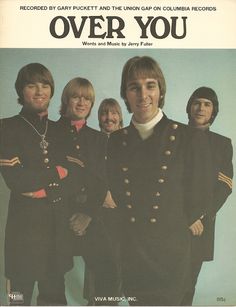
Lady Willpower/Daylight Stranger/Over You/If The Day Would Come
Gary Puckett & The Union Gap (initially credited as The Union Gap featuring Gary Puckett) was an American pop rock group active in the late 1960s. Their biggest hits were "Woman, Woman"; "Over You"; "Young Girl"; and "Lady Willpower." It was formed by Gary Puckett, Gary 'Mutha' Withem, Dwight Bement, Kerry Chater, and Paul Wheatbread, who eventually named it The Union Gap. It featured costumes that were based on the Union Army uniforms worn during the American Civil War. They were noticed by Jerry Fuller, who gave them a recording contract with Columbia Records. The group eventually grew unhappy with doing material written and produced by other people, leading them to stop working with Fuller. The band eventually disbanded and Puckett went on to do both solo work and collaborations.
"Lady Willpower" is a song written by Jerry Fuller and recorded by Gary Puckett & The Union Gap for their 1968 album, Incredible. It is sung from the point of view of a man who is frustrated that the woman he is seeing will not agree to have sex with him. He promises, if she complies, to "shower [her] heart with tenderness," but it is also implicit that the relationship will end ("It's now or never") if she does not. The song hit #1 on the Cash Box Top 100 and #2 on the Billboard Hot 100 in 1968. It also reached #5 on the UK Singles Chart during the year. The single was awarded a million-selling Gold disc from the RIAA. It ranked among Cash Box magazine's Top 100 singles of 1968, where it hit the #1 position the week ending August 3, 1968. The song was the #34 song on the Billboard Year-End Hot 100 singles in 1968
"Over You" is a hit song written by Jerry Fuller and recorded by Gary Puckett & The Union Gap for their 1968 album, Incredible. The song reached #3 on the Adult Contemporary chart. It peaked at #5 in Cash Box as well as #7 on the Billboard Hot 100 chart in late 1968. This cut was the group's fourth consecutive million-selling Gold-certified single produced and written by Jerry Fuller. It received a Gold disc from the RIAA in December 1968. The song was an international success, reaching #3 in Canada, #6 in Australia, and #17 in New Zealand. It ranked #41 on the US Cashbox chart Top 100 Hits of 1968.
Billy J. Kramer - 1964 - Little Children FLAC
Little Children/They Remind Me Of You/Beautiful Dreamer/ I Call Your Name
One of the most popular Merseybeat singers, Billy J. Kramer (born Billy Ashton) was one of the most mild-mannered rockers of the entire British Invasion. He wasn't that noteworthy a singer, either, and more likely than not would have never been heard outside of northern England if he hadn't been fortunate enough to become a client of Beatles manager Brian Epstein. Even more crucially, he was gifted with several Lennon-McCartney songs in 1963 and 1964, several of which the Beatles never ended up recording. That gave him his entrance into the charts on both sides of the Atlantic, but Kramer couldn't sustain his success after the supply of Lennon-McCartney tunes dried up. Significant? No. Enjoyable? Yes. Even tossing aside the considerable value of hearing otherwise unavailable Lennon-McCartney compositions, his best singles were enjoyably wimpy, melodic pop/rock, offering a guilty pleasure comparable to taking a break from Faulkner and diving into some superhero comics.
It's been reported that George Martin was reluctant to produce Kramer because of the latter's vocal deficiencies, making sure to hide the cracks in his upper register with loud piano notes in Billy's cover of "Do You Want to Know a Secret." No matter -- the song made it to number two in the U.K. in mid-1963, followed by another Lennon-McCartney effort, "Bad to Me." "I'll Keep You Satisfied" and "From a Window" were other gifts from the Beatles camp that gave Kramer solid hits; one Beatles reject, "I'll Be on My Way," was even relegated to a B-side (the Beatles' own BBC version was finally released in 1994). All these tunes, it should be noted, represented Lennon-McCartney at their lightest and most facile, which to a large degree explains why they didn't record the numbers for their own releases, deeming them more suitable for Kramer's fairly bland approach.

Billy J. actually landed his biggest hit, the corny pop ballad "Little Children," without assistance from his benefactors; the single also broke him, briefly, as a star in the United States, where it and its flip side ("Bad to Me") both made the Top Ten. He appeared in the legendary 1964 The T.A.M.I. Show rockumentary film, and the Dakotas recorded some instrumental rock on their own, getting a Top 20 British hit with the Ventures-ish "The Cruel Sea." Early British guitar hero Mick Green, formerly with Johnny Kidd & the Pirates, was even a Dakota briefly. But after 1965's cover of Bacharach-David's "Trains and Boats and Planes," the hits ceased, as the Beatles and Epstein's attention was lost. Kramer continued recording throughout the '60s, even briefly venturing into hard psychedelic-tinged rock, without much success, and subsequently toured often on the oldies circuit.
"Little Children" is a song written by J. Leslie McFarland and Mort Shuman. It was recorded by Billy J. Kramer & the Dakotas, and reached number one in the UK Singles Chart in March 1964, and No. 7 in the US Hot 100 singles chart later the same year. The B-side of "Little Children" in the U.S., "Bad to Me" (which had previously been an A-side in the UK which made No. 1 there in August 1963) peaked at No. 9 on the US charts simultaneously to the success of "Little Children" there.
Thursday, 30 March 2017
P.J. Proby - 1965 - The Hit Sound Of P.J. Proby FLAC
Somewhere/I Apologise/ Together/Hold Me
P.J. Proby (born James Marcus Smith, November 6, 1938) is an American singer, songwriter, and actor. He has also portrayed Elvis Presley and Roy Orbison in musical theater productions. The stage name P.J. Proby was suggested by a friend, Sharon Sheeley, who had a boyfriend of that name at high school.
Proby recorded the singles "Hold Me", "Somewhere" and "Maria". In 2008, he turned 70 and EMI released the Best of the EMI Years 1961–1972. He still writes and records on his own independent record label, Select Records, and performs in the UK in Sixties concerts.
Proby was born in Houston, Texas, United States, and educated at San Marcos Military Academy, Culver Naval Academy and Western Military Academy. After graduation he moved to California to become a film actor and recording artist. Given the stage name Jett Powers by Hollywood agents Gabey, Lutz, Heller and Loeb, he took acting and singing lessons and played small roles in films. Two singles, "Go, Girl, Go" and "Loud Perfume" appeared on an independent label. Proby was brought by Sharon Sheeley to audition at Liberty Records in 1961 and he recorded a number of unsuccessful singles. In 1962 he began writing songs and recording demos for artists such as Elvis Presley and Bobby Vee.
Success in Britain
Proby travelled to London after being introduced to Jack Good by Sheeley and Jackie DeShannon. He appeared on The Beatles' television special in 1964. Under Good, Proby had UK top 20 hits in 1964 and 1965 including "Hold Me" (UK No.3), "Together" (UK No.8, featuring guitarists Big Jim Sullivan and Jimmy Page), "Somewhere" (UK No.6) and "Maria" (UK No.8); the latter two songs were both lifted from the musical West Side Story. He also recorded the Lennon–McCartney composition "That Means a Lot", a song The Beatles attempted to record before giving it away.
Proby's UK career lost momentum after controversial live concert appearances including two trouser-splitting incidents at shows in Croydon and Luton in January 1965 that scandalized the British press and public and led to bans on Proby appearances by the ABC theatre chain, its TV namesake and BBC TV. Minor hits in 1966 were followed by flops, and in March 1968 "It's Your Day Today" gave Proby his last UK chart entry for nearly 30 years.[citation needed]
Back in the U.S.
In 1967 Proby scored his only Billboard Hot 100 Top 30 hit with "Niki Hoeky". In September 1968, he recorded Three Week Hero, released in 1969. A collection of country-style ballads mixed with blues, it used The New Yardbirds, later to become Led Zeppelin, as backing band. The album was produced by Steve Rowland.
Cilla Black - 1969 - Step Inside Love FLAC
Step Inside Love/Words/Aquarius/Surround Yourself With Sorrow
"Step Inside Love" is a song written by Paul McCartney (credited as "Lennon–McCartney") for Cilla Black in 1967 as a theme for her TV series Cilla, which first aired on 30 January 1968.
In late 1967 McCartney was approached to write the theme by Cilla and her series producer Michael Hurll. He recorded the original demo version at his London home, accompanying himself on guitar, which consisted of just one verse and the chorus.
Black's recording of this song was used as the theme during the early weeks of the show, until it was decided that the song needed an additional verse, so McCartney came to the BBC Theatre and wrote it there. According to Hurll, the opening line of the second verse ("You look tired, love") came from McCartney's observation of Cilla looking tired from the long rehearsals for the TV show. McCartney then added a third verse and this version was recorded as a studio demo at Chappell Studios in London on 21 November 1967, with McCartney on guitar accompanying Cilla on vocals. This demo was the basis for the single, although where the McCartney demos were recorded in the key of D, the final arrangement of the single version was transposed up a fourth to G, to take advantage of Cilla's higher register.
The single version of the song (with Cilla singing live over the studio backing track) was premiered on 5 March 1968 edition of her show; the single was released on 8 March 1968, and reached number eight on the British charts in April 1968. The record also reached Number 15 in Ireland in the same month. The recording was also featured on Black's third solo studio album Sher-oo!
Surround Yourself with Cilla is the title of Cilla Black's fourth solo studio album released on 23 May 1969 by Parlophone Records. It was Cilla's first album to only be recorded and released in stereo sound format, and her first to fail to make the UK charts.
The album title was inspired by the lead single "Surround Yourself with Sorrow" which had previously reached #3 on the UK Singles Chart. An Italian language version of this song "Quando Si Spezza Un Grande Amore", with Italian lyrics by Mogal, was also recorded for the Latin market, while a Swedish language version "Försök och sov på saken"
"Medley: Aquarius/Let the Sunshine In (The Flesh Failures)" (commonly called "Aquarius/Let the Sunshine In", "The Age of Aquarius" or "Let the Sunshine In") is a medley of two songs written for the 1967 musical Hair by James Rado & Gerome Ragni (lyrics), and Galt MacDermot (music) Cilla Black recorded the song for her 1969 studio album Surround Yourself with Cilla.
"Words" is a song by the Bee Gees, written by Barry, Robin & Maurice Gibb recorded by Cilla Black for her album Surround Yourself with Cilla
Wednesday, 1 March 2017
Ro!!ing St0nes - 1967 - Ruby Tuesd@y
Have You Seen Your Mother Baby, Standing In The Shadow/Paint It Black/Let's Spend the Night Together/Ruby Tuesday
The Rolling Stones are an English rock band formed in London in 1962. The original line-up consisted of Brian Jones (rhythm guitar, harmonica), Mick Jagger (lead vocals), Keith Richards (lead guitar, backing vocals), Ian Stewart (piano), Bill Wyman (bass), and Charlie Watts (drums). Stewart was removed from the official line-up in 1963 but continued as a touring member until his death in 1985. Jones left the band less than a month prior to his death in 1969, having already been replaced by Mick Taylor, who remained until 1974. After Taylor left the band, Ronnie Wood took his place in 1975 and has been on guitar in tandem with Richards ever since. Following Wyman's departure in 1993, Darryl Jones joined as their touring bassist. Other touring keyboardists for the band have been Nicky Hopkins (1967–82), Billy Preston (through the mid 1970s) and Chuck Leavell (1982-present). The band was first led by Jones, but after teaming as the band's songwriters, Jagger and Richards assumed leadership while Jones dealt with legal and personal troubles.
The Rolling Stones were at the forefront of the British Invasion of bands that became popular in the US in 1964. The band identified with the youthful and rebellious counterculture of the 1960s. They were instrumental in making blues a major part of rock and roll. After a short period of musical experimentation that peaked with the psychedelic album Their Satanic Majesties Request (1967), the group returned to its "bluesy" roots with Beggars Banquet (1968) which along with its follow-ups: Let It Bleed (1969), Sticky Fingers (1971) and Exile on Main St. (1972), is generally considered to be the band's best work and is seen as their "Golden Age". During this period, they were first introduced on stage as "The World's Greatest Rock and Roll Band". Musicologist Robert Palmer attributed the "remarkable endurance" of the Rolling Stones to being "rooted in traditional verities, in rhythm-and-blues and soul music", while "more ephemeral pop fashions have come and gone".
The band continued to release commercially successful records in the 1970s and sold many albums, including Some Girls (1978) and Tattoo You (1981), which were their most popular albums worldwide. From 1983 to 1987, tensions between Jagger and Richards almost caused the band to split. However, they managed to patch up their friendship in 1987. They separated temporarily to work on solo projects and experienced a comeback with Steel Wheels (1989), which was followed by a large stadium and arena tour. Since the 1990s, new recorded material from the group has been increasingly less well-received and less frequent. Despite this, the Rolling Stones have continued to be a huge attraction on the live circuit, with stadium tours in the 1990s and 2000s. By 2007, the band had four of the top five highest-grossing concert tours of all time: Voodoo Lounge Tour (1994–95), Bridges to Babylon Tour (1997–98), Licks Tour (2002–03) and A Bigger Bang Tour (2005–07).
The Rolling Stones were inducted into the Rock and Roll Hall of Fame in 1989 and the UK Music Hall of Fame in 2004. Rolling Stone magazine ranked them fourth on the "100 Greatest Artists of All Time" list and their estimated album sales are above 250 million. They have released 30 studio albums, 18 live albums and numerous compilations. Let It Bleed (1969) was their first of five consecutive number one studio and live albums in the UK. Sticky Fingers (1971) was the first of eight consecutive number one studio albums in the US. In 2008, the band ranked 10th on the Billboard Hot 100 All-Time Top Artists chart. In 2012, the band celebrated its 50th anniversary.
Dave Clark Five - 1966 - Wild Weekend
Wild Weekend/When/Ol' Sol/New Kind Of Love
The band started out as the Dave Clark Quintet in 1957, with Clark on drums, Dave Sanford on lead guitar, Chris Walls on bass, Don Vale on piano (and arranger). In 1958, Sanford was replaced by Rick Huxley and people were confused by the meaning of the word quintet, so the band renamed themselves the Dave Clark Five, with Stan Saxon on lead vocals, Huxley on rhythm guitar, Roger Smedley on piano and Johnny Johnson on lead guitar. Mick Ryan replaced Johnson in 1958 and Jim Spencer joined on saxophone, while Smedley left. Walls left in 1959 and Huxley became the bass player. Mike Smith joined on piano in 1960, and Lenny Davidson replaced Ryan in 1961. In 1962, the band changed its name to the Dave Clark Five when Saxon left. The group was Clark on drums, Huxley on bass, Smith on organ and lead vocals, and Davidson on lead guitar, adding Denny Payton on tenor and baritone saxophone, harmonica and guitar.
Originating in North London, the band was promoted as the vanguard of the "Tottenham Sound", a response to the Mersey Beat stable managed by Brian Epstein. Dave Clark, who formed the group, occasionally placed his drum kit at the front of the stage, with the guitarists and organ to his rear and sides, and struck business deals that allowed him to produce the band's recordings and gave him control of the master recordings. Songwriting credits went to Clark, Clark and Smith, Clark and Davidson and Clark and Payton.
The Dave Clark Five had 17 records in the Top 40 of the US Billboard chart and 12 Top 40 hits in their native UK between 1964 and 1967. Their song "Over and Over" went to number one in the US on the Billboard Hot 100 on Christmas Day 1965, despite less impressive sales in the UK (it peaked at number 45 on the UK Singles Chart), and they played to sell-out crowds on their tours of the U.S. The Dave Clark Five was the first British band of the British Invasion to tour the US, and they made 18 appearances on The Ed Sullivan Show – the most of any British Invasion group.
After the success of the Beatles' film A Hard Day's Night in 1964, the band released their own film, Catch Us If You Can (directed by John Boorman) in 1965. It also starred Barbara Ferris, and was released in the United States as Having a Wild Weekend. The short film Hits in Action highlighted a series of Dave Clark Five hits.
After their initial success, which included the film and a television special, the major hits dried up in the US after 1967's "You Got What It Takes", although the band had several substantial hits in the UK in the 1967–1970 period. Other than the songs "Inside and Out", "Maze of Love" and "Live in the Sky" (the latter actually quotes directly from the Beatles' "All You Need is Love"), the band did not follow the trend of psychedelic music.[6] The DC5 disbanded in 1970, having placed three singles on the UK chart that year, two of which reached the Top Ten. In 1970, Davidson, Huxley and Payton left and Alan Parker and Eric Ford joined on lead guitar and bass. This line-up, renamed "Dave Clark & Friends", lasted until 1973.
Tommy Boyce and Bobby Hart - Goodbye Baby
Goodbye, Baby (I Don't Want To See You Cry)/ Love Every Day/Two For The Price Of One
Tommy Boyce and Bobby Hart, the duo whose instinctive marriage of folk-rock and pre-bubblegum teen pop created and defined the Monkees sound.
Boyce and Hart each started out as teenage rock’n’rollers in late 1950s Los Angeles and first met in 1960. Some early compositions were ‘Be My Guest’, written by Boyce for Fats Domino in 1959, and ‘Beverly Jean’, one of the handful of Boyce compositions recorded by Curtis Lee and ‘Too Many Teardrops’, an early Bobby Hart solo single.
By 1963 both had relocated to New York, where they began writing as a team. They made their big breakthrough the following year with ‘Come A Little Bit Closer’, a Top 3 hit for Jay & the Americans, which helped land the twosome a contract with leading music publishers Screen Gems.
They reached the peak of their success and creativity in 1966, writing for and producing the Monkees. By the end of 1966 the Monkees had recorded nearly 50 titles, 21 of them Boyce and Hart songs – quite an achievement considering they were in competition with Carole King, Gerry Goffin and the rest of the Screen Gems stable.
Apart from the duo’s joint compositions, they were co-writers with other composers. ‘Never Again’ by the Royalettes and ‘Hurt So Bad’, as defined by Little Anthony & the Imperials, stem from Bobby Hart’s spell collaborating with Teddy Randazzo. ‘Action’ – the theme for TV’s Where The Action Is, by Paul Revere & the Raiders – and ‘Tomorrow’s Gonna Be Another Day’ by Sir Raleigh & the Cupons represent Tommy Boyce’s brief partnership with Steve Venet. And Wes Farrell gets a look-in via three songs co-written with Boyce and Hart.
Come 1969 Tommy Boyce and Bobby Hart were stars in their own right, with four hit singles and three albums to their name.
Friday, 17 February 2017
Gary Puckett And The Union Gap - 1968 - Young Girl
Young Girl/ I'm Losing You/Woman, Woman/Don't Make Promises
Frontman Puckett was born October 17, 1942, in of all places Hibbing, MN, (where Bob Dylan went to high school). Raised primarily in Yakima, WA, he picked up the guitar as a teen, and while attending college in San Diego played in a number of local bands before quitting school to focus on music. Puckett eventually landed with the Outcasts, a hard rock group comprised of bassist Kerry Chater, keyboardist Gary "Mutha" Withem, tenor saxophonist Dwight Bement, and drummer Paul Wheatbread. Despite earning a strong local following, in 1966 Wheatbread relocated to Los Angeles to serve as the house drummer on the television series Where the Action Is; the remaining members of the Outcasts toured the Pacific Northwest, and on their return, Wheatbread also moved back to San Diego and rejoined the lineup. For reasons unknown, manager Dick Badger -- convinced his charges needed a strong visual hook -- then sent the group to Tijuana, where they were outfitted with Union Army-style Civil War uniforms.
A demo was soon cut in L.A., and Badger arranged a meeting with CBS producer Jerry Fuller. Though impressed by Puckett's soaring baritone, Fuller believed the band's gritty, R&B-influenced approach was all wrong, but agreed to check out their live show at the San Diego bowling alley the Quad Room. Believing Fuller was due to arrive on Saturday, the Outcasts opted to save their energy, delivering an atypically mellow set on Friday night. Fuller, who was in the crowd for both shows, signed the group contingent on their willingness to foster their latent soft rock leanings. Re-christened the Union Gap in honor of a suburb of Yakima, on August 16, 1967, the band recorded its first single, "Woman Woman." Suggesting a mellower Righteous Brothers sans producer Phil Spector's majestic firepower, the single reached the Top Ten late in 1967 and was a million-seller by February of 1968; concurrent CBS press releases gave each member his own imaginary military rank -- Puckett was the general, Bement the sergeant, Chater the corporal, and both Withem and Wheatbread were relegated to privates.
In the spring of 1968, the Union Gap scored their biggest hit, "Young Girl," written by Fuller in the style of "Woman, Woman," but exchanging the age-old theme of infidelity for the age-old theme of the temptation of underage romance: "My love for you is way out of line/you better run, girl, you're much too young, girl," an anguished Puckett wailed. The juggernaut rolled on, and the group continued rattling off hits -- "Lady Willpower," "Over You," and "Don't Give in to Him" among them -- and also headlined at the White House and Disneyland. But there was dissension in the ranks: the Union Gap wanted to write and produce their own material, and Puckett found himself increasingly confined within the CBS-mandated ballad formula. In 1969, stalemate: Fuller assembled a 40-piece studio orchestra for a new song he had written, but Puckett and the Union Gap refused to cut the tune. The session was ultimately canceled, and Fuller never again worked with the group. For the Union Gap, it was a pyrrhic victory.
The band immediately returned to the Top Ten that autumn with the Dick Glasser-produced "This Girl Is a Woman Now," but it was to be their last hit. The follow-up, "Let's Give Adam and Eve Another Chance," tanked, and after management dictated that Puckett's bandmates now receive a weekly salary instead of a percentage of the revenue, Chater and Withem left the band. Bement assumed bass duties, keyboardist Barry McCoy and horn player Richard Gabriel were added, and gospel vocalists the Eddie Kendrick Singers also signed on. The Civil War gear was soon jettisoned, but even so, prospects did not improve. In 1970, Puckett began recording as a solo act, but his efforts were not well-received; the Union Gap remained his live backing unit, until they were dismissed following an appearance at the 1971 Orange County Fair. Puckett's contract with CBS was terminated one year later.
Puckett continued making solo appearances in the months to come, but by 1973 he had essentially disappeared from music, opting instead to study acting and dance. He performed in theatrical productions in and around L.A., but his acting career never really took off, and in 1984 he signed on with the Happy Together oldies package tour. Two years later, Puckett was tapped to open for the Monkees on their 20th Anniversary tour, and he remained a staple of the revival circuit into the next century. Among his original bandmates, Bement later joined the oldies act Flash Cadillac and the Continental Kids, while Chater relocated to Nashville, where he plied his trade as a songwriter. Wheatbread, meanwhile, turned to concert promotion, and Withem returned to San Diego to teach high-school band.
Johnny Burnett - 1963 - Hit After Hit FLAC
Dreamin'/Little Boy Sad/Girls/You're Sixteen
A contemporary of Elvis Presley in the Memphis scene of the mid-'50s, Johnny Burnette played a similar brand of fiery, spare wildman rockabilly. With his brother Dorsey (on bass) and guitarist Paul Burlison forming his Rock 'n' Roll Trio, he recorded a clutch of singles for Decca in 1956 and 1957 that achieved nothing more than regional success. Featuring the groundbreaking fuzzy tone of Burlison's guitar, Johnny's energetic vocals, and Dorsey's slapping bass, these recordings -- highlighted by the first rock & roll version of "Train Kept A-Rollin'" -- compare well to the classic Sun rockabilly of the same era. The trio disbanded in 1957, and Johnny found pop success as a teen idol in the early '60s with hits like "You're Sixteen" and "Dreamin'." Burnette died in a boating accident in 1964. His brother Dorsey achieved modest success as a solo act in the early '60s, and Burlison resurfaced as a member of the Sun Rhythm Section.
J@nis Jopl!n - 1971 - J@nis Jopl!n FLAC
Me And Bobby McGee/Mercedes Benz/Cry Baby/Half Moon
Janis Lyn Joplin (January 19, 1943 – October 4, 1970) was an influential American singer of the 1960s; her raw, powerful and uninhibited singing style, combined with her turbulent and emotional lifestyle, made her one of the biggest female stars in her lifetime. She died of an accidental drug overdose in 1970, aged 27, after releasing three albums. A fourth album, Pearl, was released a little more than three months after her death, reaching number 1 on the charts.
Joplin rose to fame in 1967 during an appearance at Monterey Pop Festival, as the lead singer of the then little-known San Francisco psychedelic rock band Big Brother and the Holding Company. After releasing two albums with the band, she left Big Brother to continue as a solo artist with her own backing groups, first the Kozmic Blues Band and then the Full Tilt Boogie Band. She appeared at the Woodstock festival and the Festival Express train tour. Five singles by Joplin went into the Billboard Top 100, including "Me and Bobby McGee", which reached number 1 in March 1971. Her most popular songs include: "Piece of My Heart"; "Cry Baby"; "Down on Me"; "Ball 'n' Chain"; "Summertime"; and "Mercedes Benz", the final song she recorded.
Joplin, who was inducted into the Rock and Roll Hall of Fame in 1995, was well known for her performing ability. Audiences and critics alike referred to her stage presence as "electric". Rolling Stone ranked Joplin number 46 on its 2004 list of the 100 Greatest Artists of All Time and number 28 on its 2008 list of 100 Greatest Singers of All Time. She remains one of the top-selling musicians in the United States, with Recording Industry Association of America certifications of 15.5 million albums sold in the USA.
Wilson Picket - 1968 - Stag-O-Lee FLAC
Stag-O-Lee/ I'm In Love/Soul Dance Number Three/Funky Broadway
Of the major '60s soul stars, Wilson Pickett was one of the roughest and sweatiest, working up some of the decade's hottest dancefloor grooves on hits like "In the Midnight Hour," "Land of 1000 Dances," "Mustang Sally," and "Funky Broadway." Although he tends to be held in somewhat lower esteem than more versatile talents like Otis Redding and Aretha Franklin, he is often a preferred alternative of fans who like their soul on the rawer side. He also did a good deal to establish the sound of Southern soul with his early hits, which were often written and recorded with the cream of the session musicians in Memphis and Muscle Shoals.
Before establishing himself as a solo artist, Pickett sang with the Falcons, who had a Top Ten R&B hit in 1962 with "I Found a Love." "If You Need Me" (covered by the Rolling Stones) and "It's Too Late" were R&B hits for the singer before he hooked up with Atlantic Records, who sent him to record at Stax in Memphis in 1965. One early result was "In the Midnight Hour," whose chugging horn line, loping funky beats, and impassioned vocals combined into a key transitional performance that brought R&B into the soul age. It was an R&B chart-topper and a substantial pop hit (number 21), though its influence was stronger than that respectable position might indicate: thousands of bands, black and white, covered "In the Midnight Hour" on-stage and record in the 1960s.
Pickett had a flurry of other galvanizing soul hits over the next few years, including "634-5789," "Mustang Sally," and "Funky Broadway," all of which, like "In the Midnight Hour," were frequently adapted by other bands as dance-ready numbers. The king of that hill, though, had to be "Land of 1000 Dances," Pickett's biggest pop hit (number six), a soul anthem of sorts with its roll call of popular dances, and covered by almost as many acts as "Midnight Hour" was.
Pickett didn't confine himself to the environs of Stax for long; soon he was also cutting tracks at Muscle Shoals. He recorded several early songs by Bobby Womack. He used Duane Allman as a session guitarist on a hit cover of the Beatles' "Hey Jude." He cut some hits in Philadelphia with Gamble & Huff productions in the early '70s. He even did a hit version of the Archies' "Sugar, Sugar." The hits kept rolling through the early '70s, including "Don't Knock My Love" and "Get Me Back on Time, Engine Number 9."
One of the corollaries of '60s soul is that if a performer rose to fame with Motown or Atlantic, he or she would produce little of note after leaving the label. Pickett, unfortunately, did not prove an exception to the rule. His last big hit was "Fire and Water," in 1972. He continued to be active on the tour circuit; his most essential music, all from the 1960s and early '70s, was assembled for the superb Rhino double-CD anthology A Man and a Half. It's Harder Now, his first new material in over a decade, followed in 1999. Pickett spent the early part of the 2000s performing, before retiring in late 2004 due to ill health. He passed away on January 19, 2006, following a heart attack.
Stevie Wonder - 1969 - For Once In My Life FLAC
I'm Wondering/My Cherie Armour/Yester-Me, Yester-You, Yesterday/For Once In My Life
Stevland Hardaway Morris (born Stevland Hardaway Judkins; May 13, 1950), known by his stage name Stevie Wonder, is an American musician, singer, songwriter, record producer, and multi-instrumentalist. A child prodigy, he is considered to be one of the most critically and commercially successful musical performers of the late 20th century. Wonder signed with Motown's Tamla label at the age of 11, and he continued performing and recording for Motown into the 2010s. He has been blind since shortly after birth.
Among Wonder's works are singles such as "Superstition", "Sir Duke", "You Are the Sunshine of My Life" and "I Just Called to Say I Love You"; and albums such as Talking Book, Innervisions and Songs in the Key of Life. He has recorded more than 30 U.S. top ten hits and received 25 Grammy Awards, one of the most-awarded male solo artists, and has sold over 100 million records worldwide, making him one of the top 60 best-selling music artists. Wonder is also noted for his work as an activist for political causes, including his 1980 campaign to make Martin Luther King Jr.'s birthday a holiday in the United States. In 2009, Wonder was named a United Nations Messenger of Peace. In 2013, Billboard magazine released a list of the Billboard Hot 100 All-Time Top Artists to celebrate the US singles chart's 55th anniversary, with Wonder at number six.
"For Once in My Life" is a swing song written by Ron Miller and Orlando Murden for Motown Records' Stein & Van Stock publishing company, and first recorded in 1966. The most familiar and successful version of "For Once in My Life" is an uptempo arrangement by Stevie Wonder, recorded in 1967. Wonder's version, issued on Motown's Tamla label, was a top-three hit in the United States and the United Kingdom in late 1968 and early 1969.
My Cherie Amour" is a 1969 soul classic by Motown singer-songwriter Stevie Wonder. The song was originally recorded from late 1967 to early 1968, but not released until early 1969. The song was co-written by Wonder, Sylvia Moy, and Henry Cosby; Cosby also served as producer of the song. The song became a #4 hit on both the Billboard pop and R&B singles charts in July 1969. Wonder also released Spanish- and Italian-language versions entitled "Mi Querido Amor" and "My Cherie Amor", respectively.
"Yester-Me, Yester-You, Yesterday" is a 1969 soul song written by Ron Miller and Bryan Wells, released by American Motown singer-songwriter-musician Stevie Wonder on the album My Cherie Amour. The song continued Wonder's success on the pop charts. It reached #7 on the pop singles chart and become Wonder's ninth Top 10 single of the 1960s. The single fared even better on the UK singles chart where it reached #2 in December 1969, and at that time, it was Wonder's biggest UK hit.
"I'm Wondering" is a single released by Stevie Wonder as a non-album single in 1967. It peaked at No. 12 on the Billboard Hot 100. It was a hit in Great Britain as well, where it made #22 on the Pop Charts. The single was released after his album, I Was Made to Love Her, had made its debut.
Byrds - 1988 - 4 Play FLAC
Mr.Tambourine Man/Turn! Turn! Turn! (To Everything There Is A Season)/All I Really Want To Do/Mr. Spaceman
The Byrds were an American rock band that were formed in Los Angeles, California in 1964. Although the band only enjoyed the huge commercial success of contemporaries like The Beatles or The Beach Boys for a short period of time (1965–1966), they were pivotal in originating the musical styles of folk rock, psychedelic rock, raga rock, and country rock. The band underwent several line-up changes throughout its existence, with frontman Roger McGuinn remaining the sole consistent member of the group until their disbandment in 1973.
"Mr. Tambourine Man" was the debut single by the American band The Byrds and was released on April 12, 1965 by Columbia Records. The song was also the title track of the band's debut album, Mr. Tambourine Man, which was released on June 21, 1965. The Byrds' version is abridged and in a different key from Dylan's original. The single's success initiated the folk rock boom of 1965 and 1966, many acts imitating the band's hybrid of rock beat, jangly guitar and poetic or socially conscious lyrics. The single, the "first folk rock smash hit", gave rise to the very term "folk rock" in the U.S music press to describe the band's sound. The single reached number 1 on the Billboard Hot 100, and number 1 on the UK Singles Chart, making it the first recording of a Dylan song to reach number 1 on any pop music chart
"All I Really Want to Do" is a song written by Bob Dylan and featured on his Tom Wilson-produced 1964 album, Another Side of Bob Dylan.
It was the second single by the American folk rock band the Byrds, and was released on June 14, 1965 by Columbia Records (see 1965 in music). The song was also included on the band's debut album, Mr. Tambourine Man, which was released on June 21, 1965. The version of the song released as a single is a completely different take to the version found on the Mr. Tambourine Man album, as evidenced by the slight lyrical variations in the song's first verse and the different running times the two versions have; the single is 2:02 minutes in length while the album version is slightly longer at 2:04. The single reached #40 on the Billboard Hot 100 and #4 on the UK Singles Chart.
"Turn! Turn! Turn! (To Everything There Is a Season)" — often abbreviated to "Turn! Turn! Turn!" — is a song written by Pete Seeger in the late 1950s. The song became an international hit in late 1965 when it was covered by the American folk rock band The Byrds, entering at #80 on October 23, 1965, before reaching #1 on the Billboard Hot 100 chart on December 4, 1965, #3 in Canada (Nov. 29, 1965), and also peaking at #26 on the UK Singles Chart. In the U.S., the song holds distinction as the #1 hit with the oldest lyrics.
"Mr. Spaceman" is a song by the American rock band The Byrds and was the third track on their 1966 album Fifth Dimension. The song was initially written by band member Jim McGuinn as a "melodramatic screenplay" but it soon evolved into a whimsical meditation on the existence of extraterrestrial life. After its appearance on Fifth Dimension, "Mr. Spaceman" was released as the third single taken from that album in September 1966 (see 1966 in music). The single reached #36 on the Billboard Hot 100 but failed to chart in the United Kingdom.
Nazareth - 1977 - Hot Tracks
Love Hurts/This Flight Tonight/Broken Down Angel/Hair Of The Dog
Nazareth formed in December 1968 in Dunfermline, Scotland, from the remaining members of semi-professional local group The Shadettes (formed in 1961) by vocalist Dan McCafferty, guitarist Manny Charlton (ex Mark V and The Red Hawks), bassist Pete Agnew, and drummer Darrell Sweet. They were inspired by The Beatles and The Rolling Stones. Nazareth took their name from Nazareth, Pennsylvania, which is cited in the first line of The Band's classic song "The Weight" ("I pulled into Nazareth / Was feelin' about half past dead..."). Nazareth's cover version of "Java Blues" by The Band's bassist/singer Rick Danko and Emmett Grogan is on their 1981 live album Snaz.
The band moved to London, England in 1970 and released their eponymous debut album in 1971. After getting some attention with their second album Exercises, released in 1972, Nazareth supported Deep Purple on tour, and issued the Roger Glover-produced Razamanaz, in early 1973. This collection spawned two UK Top Ten hits, "Broken Down Angel" and "Bad Bad Boy". This was followed by Loud 'N' Proud in late 1973, which contained another hit single with a cover of Joni Mitchell's song "This Flight Tonight". Then came another album Rampant, in 1974, that was equally successful although its only single, "Shanghai'd in Shanghai", narrowly missed the British Top 40. A non-album song, again a cover version, this time of Tomorrow's "My White Bicycle", was a UK Top 20 entry in 1975.
Hair of the Dog was released in April 1975 and was produced by Manny Charlton, ending Roger Glover's association with the band. The title track of that album (popularly, though incorrectly, known as "Son of a Bitch" due to its hook lyric) became a staple of 1970s rock radio. The American version of the album included a song originally recorded by The Everly Brothers, the melodic Boudleaux Bryant-penned ballad "Love Hurts", that was released as a hit single in the UK and in the US, where it went platinum. The track became the band's only US Top Ten hit. and was also a top 10 hit in nine other countries, reaching number 1 in six of them. The song was on the Norwegian chart for 60 weeks.
Partridge Family - 1973 - Looking Through The Eyes Of Love
Looking Through The Eyes Of Love/Breaking Up Is Hard To Do/It's One Of Those Nights/Am I Losing You
The Partridge Family is an American musical-sitcom starring Shirley Jones and featuring David Cassidy. Jones plays a widowed mother, and Cassidy plays the oldest of her five children who embark on a music career. It ran from September 25, 1970, until March 23, 1974, on the ABC network as part of a Friday-night lineup, and had subsequent runs in syndication. The family was loosely based on the real-life musical family The Cowsills, a popular band in the late 1960s and early 1970s.
The Partridge Family was produced for ABC by Screen Gems. The company promoted the show by releasing a series of albums featuring the family band, though David Cassidy and Shirley Jones, who sang background, were the only cast members who were actually featured on the recordings.
As the show and other associated merchandising soared, David Cassidy became a teen idol.The producers signed Cassidy as a solo act as well. Cassidy began touring with his own group of musicians, performing Partridge songs as well as hits from his own albums, to thousands of screaming teenagers in major stadiums across the USA, UK, Europe, Japan and Australia.
The Partridge Family's biggest hit came in 1970 with the song "I Think I Love You", written by Tony Romeo (who had previously written several of the Cowsills' hits), peaked at Number 1 on the Billboard charts in December of that year. It sold over five million copies, outselling the Beatles' "Let It Be", was awarded a gold disc, and made the group the third fictional artist to have a No. 1 hit (after The Chipmunks and The Archies). The song's companion LP, The Partridge Family Album, reached Number 4 in the Billboard 200. It was also awarded a gold disc by the RIAA in December 1970, having sold over one million copies.
A string of hit Partridge singles followed: "Doesn't Somebody Want to Be Wanted", "I'll Meet You Halfway", "I Woke Up In Love This Morning", "It's One of Those Nights (Yes Love)", "Am I Losing You", "Looking Through the Eyes of Love", "Breaking Up Is Hard to Do", and "A Friend and a Lover". These singles were showcased on million-selling albums including Up To Date, Sound Magazine, Shopping Bag, Notebook, Crossword Puzzle, and Bulletin Board. Their holiday album A Partridge Family Christmas Card was the No. 1 selling Christmas record of 1971. Record sales success was replicated internationally, with both The Partridge Family (group) and David Cassidy (solo) achieving huge hits in Canada, Great Britain, Europe, Japan, Australia, New Zealand and South Africa. In all, The Partridge Family released 89 songs on 9 albums between 1970 and 1973.
Tuesday, 7 February 2017
Manfred Mann - 1969 - Fox On The Run
Fox On The Run/Too Many People/Ragamuffin Man/A 'B' side
Manfred Mann were an English rock band of the 1960s, named after keyboardist, Manfred Mann, who later led the successful 1970s group Manfred Mann's Earth Band. The group had two different lead vocalists during their success, Paul Jones from 1962 to 1966, and Mike d'Abo from 1966 to 1969.
Manfred Mann were regularly in the charts in the 1960s. Three of the band's most successful singles, "Do Wah Diddy Diddy", "Pretty Flamingo" and "Mighty Quinn", topped the UK Singles Chart. They were the first south-of-England-based group to top the US Billboard Hot 100 during the British invasion
The Mann-Hugg Blues Brothers were formed in London by keyboard player Manfred Mann and drummer/vibes/piano player Mike Hugg, who formed a house band in Clacton-on-Sea that also featured Graham Bond. Bringing a shared love of jazz to the British blues boom, then sweeping London's clubs (which also spawned Alexis Korner, the Rolling Stones and the Yardbirds), the band was completed by Mike Vickers on guitar, alto saxophone and flute, bassist Dave Richmond and Paul Jones as lead vocalist and harmonicist. By this time they had changed their name to Manfred Mann & the Manfreds. Gigging throughout late 1962 and early 1963 the band soon attracted attention for their distinctive sound.
Jones was replaced by Mike d'Abo in July 1966, and the group switched labels to Fontana Records, where they were produced by Shel Talmy. Their first Fontana single, Dylan's "Just Like a Woman", released in July, scraped in the UK top ten, reaching number one in Sweden. Their annual long-player, As Is, followed in October, with increased studio technique sidelining jazz, soul and blues roots and centring on the group's strongest set of songs so far. The next two singles "Semi-Detached, Suburban Mr James" and "Ha Ha Said The Clown" both reached the Top 5. Their December 1968 release, "Fox on the Run", reached No. 5 in the UK. The group split in 1969, while their final hit, "Ragamuffin Man", was in the Top 10.
Monday, 6 February 2017
T0t0 - 1988 - Four Play Vol. 1 FLAC
Hold The Line/99/Rosanna/Africa
Toto is an American rock band formed in 1977 in Van Nuys in Los Angeles. The band's current lineup consists of Joseph Williams (lead vocals), David Paich (keyboards, vocals), Steve Porcaro (keyboards), Steve Lukather (guitars, vocals), plus touring members Leland Sklar (bass) and Shannon Forrest (drums). Toto is known for a musical style that combines elements of pop, rock, soul, funk, progressive rock, hard rock, R&B, blues, and jazz.
David Paich and Jeff Porcaro had played together as session musicians on several albums and decided to form a band. David Hungate, Steve Lukather, Steve Porcaro and Bobby Kimball were recruited before their first album release. The band enjoyed great commercial success in the late 1970s and 1980s, beginning with the band's eponymous debut released in 1978. With the release of the critically acclaimed and commercially successful Toto IV (1982), Toto became one of the best-selling music groups of their era. They are best known for the Top 5 hits "Hold the Line", "Rosanna", and "Africa". Several changes to the lineup have been made over the years. Hungate left in 1982 followed by Kimball in 1984 but rejoined the band in 1998 until 2008. Jeff Porcaro died in 1992 of a heart attack. Hungate rejoined Toto as a touring musician and later a band member. In 2008, Lukather announced his departure from the band, and the remaining band members later went their separate ways. In the summer of 2010, Toto reformed and went on a short European tour, with a new lineup, to benefit Mike Porcaro, who had been diagnosed with amyotrophic lateral sclerosis (ALS) and was no longer an active member of the band. Porcaro died in 2015.
The band has released a total of 17 albums, and have sold over 40 million albums to date. The group was honored with several Grammy Awards and was inducted into the Musicians Hall of Fame and Museum in 2009.
Saturday, 4 February 2017
Ben E King - 1963 - Spanish Harlem FLAC
Spanish Harlem/First Taste Of Love/Don't Play That Song (You Lied)/The Hermit Of Misty Mountain
Benjamin Earl King (September 28, 1938 – April 30, 2015), known as Ben E. King, was an American soul and R&B singer and record producer. He was perhaps best known as the singer and co-composer of "Stand by Me"—a US Top 10 hit, both in 1961 and later in 1986 (when it was used as the theme to the film of the same name), a number one hit in the UK in 1987, and no. 25 on the RIAA's list of Songs of the Century—and as one of the principal lead singers of the R&B vocal group the Drifters notably singing the lead vocals of one of their biggest global hit singles (and only U.S. #1 hit) "Save the Last Dance for Me".
It was originally released as the B-side to "First Taste of Love". The song was King's first hit away from The Drifters, a group he had led for several years. With an arrangement by Stan Applebaum featuring Spanish guitar, marimba, drum-beats, soprano saxophone, strings, and a male chorus, it climbed the Billboard charts, eventually peaking at #15 R&B and #10 Pop. It was ranked #358 on Rolling Stone's list of the 500 Greatest Songs of All Time. King's version was not a hit in the UK: instead, the original A-side, "First Taste of Love", that was played on Radio Luxembourg, charting at #27. In 1987, after Stand By Me made #1, the song was re-released and charted at #9
similarly, in a 2009 radio interview with Leiber and Stoller on the Bob Edwards Weekend talk show, Jerry Leiber said that Stoller, while uncredited, had written the key instrumental introduction to the record.[citation needed] In the team's autobiography from the same year, Hound Dog, Stoller himself remarks that he had created this "fill" while doing a piano accompaniment when the song was presented to Ahmet Ertegun and Jerry Wexler at Atlantic Records, with Spector playing guitar and Leiber doing the vocal. "Since then, I've never heard the song played without that musical figure. I presumed my contribution was seminal to the composition, but I also knew that Phil didn't want to share credit with anyone but Jerry, so I kept quiet."
Subscribe to:
Posts (Atom)